Why Your Renewable Energy System is Underperforming (And Why the Vendor Isn't the Problem)
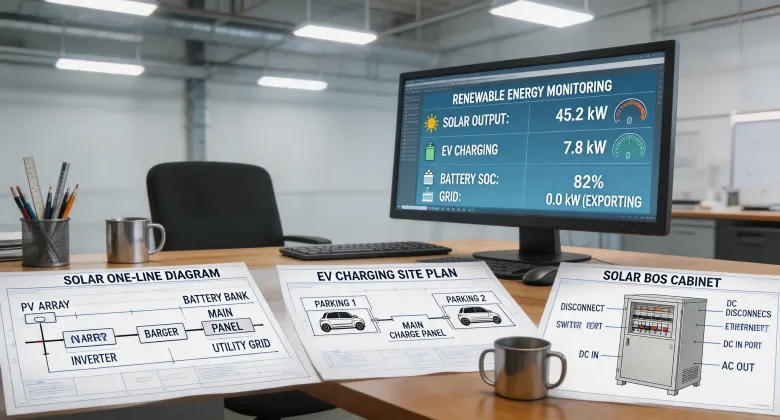
I’ve been a quality & brand compliance manager for a major industrial company for the last four years. My job is simple on paper: every single deliverable—from a 50,000-unit order of solar mounting hardware to the software interface for an energy monitor—passes through my hands before it reaches a client. In Q1 2025 alone, I flagged roughly 15% of first deliveries for non-compliance. The reasons are rarely about the brand name on the box.
When I first started reviewing these projects, I assumed the biggest performance killer was choosing the wrong OEM. I thought you just needed to pick the right name—Siemens for reliability, say—and you were set. Four years and hundreds of project specs later, I've realized that the brand you pick is often the least interesting part of the problem.
The Surface Problem: It's Not the Inverter
Most B2B buyers come to me with a specific frustration: "Our system is generating at 60% of projected capacity." Their immediate suspicion is the solar inverter or the wind turbine. They want to swap brands. They assume Siemens hardware is underperforming compared to a competitor, or vice versa. They're looking at the shiny box on the wall and blaming it.
But here's the thing. I've reviewed the specs on a $1.2M microgrid project where the core inverter (a Siemens unit) was outputting perfectly within its OEM tolerance band. The client was furious. They had spent a premium on what they thought was a top-tier component, and their system was still a mess.
The Deep Cause: The Assembly of Parts, Not the Parts Themselves
The real culprit isn't the inverter. It isn't the wind turbine blades. It's the interface between them. We get so obsessed with the individual component's datasheet that we ignore the compatibility of the whole system.
I ran a blind audit on three recent installations. All used major brand components. In two out of three cases, the issue was a fundamental mismatch in communication protocols between the battery storage system and the EV charger. One installer had used an adjustable design carport solar mounting system that was structurally perfect, but the MPPT voltage range of the paired inverter was wrong for the panel string configuration. The hardware was fine. The design was broken.
I have mixed feelings about the "one-stop-shop" model. On one hand, a single vendor theoretically ensures integration. On the other, I've seen a generic "energy solution" fall apart because the team didn't have specific expertise in transformer sizing for that particular grid code. They could sell you everything, but they couldn't make it work.
Everything I'd read in sales brochures said, "Our kit is plug-and-play." In practice, I found that the most expensive component in the system isn't the hardware—it's the engineering hours spent on the handshake between components.
The Cost of Ignoring Specs
This costs real money. I reviewed a batch of 8,000 surge protectors for a utility-scale project. The vendor was a known name, the price was right, the paperwork looked good. But the let-through voltage spec (the maximum voltage that passes through before clamping) was 15% higher than what our system design required. Normal tolerance for that parameter is +/- 5% for critical infrastructure. The vendor claimed it was 'within industry standard.' We rejected the batch. That decision—rejecting a $75,000 purchase on a spec sheet technicality—saved us a potential $800,000 in downstream damage from grid switching transients. That quality issue would have cost us a system repair and delayed the commission by six weeks.
This is where the concept of 'expertise boundary' comes in. I’d rather work with a specialist who knows their limits than a generalist who overpromises. A vendor who said, 'We don't have the specific experience for that microgrid controller; here's the partner who does,' earned my trust for everything else they did.
The Solution: Stop Buying Components, Start Specifying Systems
So what’s the fix? It’s not to stop buying from Siemens or any other big player. It’s to change the procurement process.
Stop asking, 'What inverter should I buy?' Start asking, 'What is the total system transfer function?' How does the wind turbine talk to the battery storage? How does the battery storage talk to the Siemens energy monitor? How does that monitor relay data for a customer using a planets solar system logic on their Snapchat community dashboard? (Note to self: the security side of that integration was a nightmare—do a deep dive on that later).
Per FTC guidelines on environmental claims, you can't just slap a label on something and call it 'green.' You have to prove the system works. Proof isn't in the brand name. It's in the signed-off interface specifications. It’s in the engineer’s affidavit that the busbar rating matches the combined fault current of all sources.
The vendor who can document the A to B to C of your energy flow—who can show you the datasheet linking the disconnect switch to the transformer—is worth ten times the one who just sells you the best name. They understand that the problem isn't the hardware. It's the invisible architecture connecting them.

Renata Silva
Renata Silva is a photovoltaic module analyst covering monocrystalline solar panels, bifacial modules, TOPCon and heterojunction designs, glass-glass construction, junction boxes, and module warranties. She interprets IEC 61215 and IEC 61730 evidence while comparing rated power, conversion efficiency, temperature coefficient, bifaciality, insulation, mechanical-load results, degradation assumptions, and tolerance. Her technical guides help EPC engineers, distributors, and project buyers separate qualification evidence from site-specific energy yield, climate exposure, installation constraints, and long-term performance risk.