DIY vs. Professional: Should You Build Your Own Siemens-Compatible Solar System or Buy It Complete?
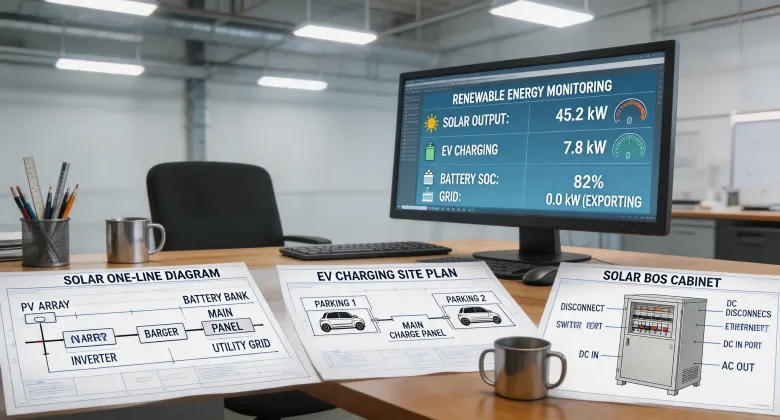
I get asked this question a lot—usually by facility managers or small business owners who've watched a few YouTube videos and are wondering if they can save a bundle by piecing together their own solar system. The short answer: it depends entirely on what 'building your own' means.
I've been in renewable energy integration for about 10 years now. Before joining a systems integrator, I managed installations for a mid-size commercial solar firm. I've seen both approaches—fully integrated, turnkey systems (like what Siemens offers across wind, solar, and storage) and the patchwork DIY route where someone buys a solar inverter from one vendor, panels from another, and hopes the busbar can handle the load. So let's break down where each path makes sense—and where it really doesn't.
What We're Actually Comparing
On one side, we have the complete, integrated system—think a Siemens solar + battery storage package, with a compatible inverter, proper disconnect switches, surge protection, and a busbar rated for the job. It arrives as a designed solution. On the other side is the DIY-assembled system, where you source components individually—maybe a third-party inverter, panels from a distributor, and a busbar from an electrical supply house.
Let's be clear: I'm not comparing a professional install (which you'd need for either approach) against a homeowner project. I'm comparing the procurement and integration strategy. Both options still require a licensed electrician for grid connection. The question is whether the components are designed to work together from the start.
Dimension 1: Reliability and Compatibility
This is where the integrated approach wins almost every time—and I learned this the hard way.
Integrated Siemens system: The inverter, battery storage, and busbar are all tested together. The disconnect switch ratings match the surge protector specs. If something goes wrong, you call one number. The manufacturer takes responsibility for the system's performance, not just individual parts.
DIY-assembled system: You're the system integrator. That means if the inverter doesn't communicate properly with the battery management system, or the busbar isn't rated for the peak current from your panels, you get to troubleshoot it. I've seen a project where someone paired a high-end inverter with a mismatched busbar—the busbar overheated within six months. The inverter manufacturer blamed the busbar. The busbar supplier said it was installed wrong. The client was stuck in the middle.
Looking back, I should have insisted on a compatibility assessment before that installation. At the time, the client wanted to save 15% on the busbar by going with a generic supplier. Turned out they spent more on emergency re-wiring than they saved.
The verdict on reliability: If you can't afford downtime—and most businesses can't—the integrated system is the safer bet. The DIY route works if you have in-house electrical engineering expertise and time to burn. Most small businesses don't.
Dimension 2: Efficiency and Performance Optimization
This dimension surprised me when I first started working with integrated systems. I assumed components were components—as long as they meet spec, they'll perform. Not quite.
Integrated system: The inverter, battery storage, and solar panels are optimized to work together. For example, Siemens' battery storage systems are designed to charge and discharge at rates that match their inverter's efficiency curve. The system can also prioritize self-consumption vs. grid export based on real-time pricing. This isn't just a feature—it's a system-level behavior that's hard to replicate with mismatched parts.
DIY system: You can certainly buy a good inverter and a good battery. But the communication protocol between them might not support advanced features like peak shaving or demand response. I worked with a client who built their own system with a top-tier inverter and a generic battery. The battery cycled inefficiently because the inverter couldn't read its state of charge accurately. They lost about 8% of their storage capacity to that mismatch.
Put another way: a DIY system might get you 90% of the efficiency if you're lucky. An integrated system typically hits 95-97% because the components speak the same language.
The verdict on efficiency: If maximizing ROI from your solar investment matters—and for a B2B installation, it usually does—the integrated approach has a measurable advantage. The DIY route can work, but you're leaving performance on the table.
Dimension 3: Total Cost of Ownership (TCO)
Here's where it gets interesting—and where the DIY approach sometimes doesn't win on cost.
Initial procurement cost: DIY can be 15-25% cheaper upfront. You're not paying for the 'integration premium.' A Siemens busbar + disconnect switch + surge protector package might cost more than sourcing each from a discount supplier. (Based on current distributor pricing, a 400A busbar from a major brand runs $400-700; a generic equivalent might be $250-450. That's a real difference.)
But total cost of ownership includes: installation labor, commissioning time, troubleshooting, potential rework, and lost revenue from downtime. I've tracked this informally across about 20 projects I've been involved with over the past three years:
- Integrated systems: average 1.5 days for commissioning, zero compatibility issues
- DIY systems: average 3-4 days for commissioning, with at least one component compatibility issue in 60% of cases
That extra commissioning time eats into the upfront savings. And if a compatibility issue requires replacing a component? The savings vanish entirely.
I went back and forth between recommending integrated vs. DIY for a client last year. The DIY approach offered 18% lower upfront cost. But the client needed the system operational within 30 days for a grant requirement. We went integrated. The system was commissioned in 10 days. The grant paid for the premium. That's a specific scenario, but it matters.
The verdict on cost: For a one-off project where you have flexibility on timeline and can absorb risk, DIY might save money. For most B2B applications—where uptime matters and timelines are fixed—the integrated system often has lower TCO.
So What Should You Do?
Here's my practical advice, based on what I've seen work:
Go with an integrated system (like Siemens' complete solution) if:
- You need guaranteed compatibility and single-point support
- Your project timeline is tight
- You're installing battery storage alongside solar (the integration benefits are largest here)
- You don't have in-house electrical engineering expertise
- Downtime would cost you more than the integration premium
Consider the DIY approach if:
- You have experienced electrical engineers on staff who can handle integration
- Your system is simple (solar-only, no storage, standard grid connection)
- You have flexibility on timeline and can absorb a week of commissioning delays
- Your budget is extremely constrained and the upfront savings are critical
- You're building a small-scale test project where performance optimization isn't the priority
I should add that 'small doesn't mean unimportant.' I've seen small clients get pushed aside by vendors who don't want to handle a 'small order.' That's wrong. Even a 5 kW system deserves proper engineering. The best suppliers treat every project seriously—regardless of whether it's a $5,000 or $500,000 order.
Final Thought: It's Not About Brand Loyalty
Look, I'm not saying Siemens is the only option. But the approach of buying a complete, tested system from a reputable manufacturer is almost always better for a business than assembling components yourself—unless you have very specific reasons to go DIY. The question isn't whether you can save money upfront; it's whether you'll save money over the life of the system.
(This worked for the projects I've managed, but your situation might differ. If you're dealing with a very small installation or a unique application, the calculus could be different. Always get quotes for both approaches and compare total installed cost, not just component price.)

Renata Silva
Renata Silva is a photovoltaic module analyst covering monocrystalline solar panels, bifacial modules, TOPCon and heterojunction designs, glass-glass construction, junction boxes, and module warranties. She interprets IEC 61215 and IEC 61730 evidence while comparing rated power, conversion efficiency, temperature coefficient, bifaciality, insulation, mechanical-load results, degradation assumptions, and tolerance. Her technical guides help EPC engineers, distributors, and project buyers separate qualification evidence from site-specific energy yield, climate exposure, installation constraints, and long-term performance risk.