Why I Paid More for a Siemens 100 Amp Disconnect on a Solar Storage Project
The email came in at 4:47 PM on a Friday. The inspection for the Stevenson Ranch project had been moved up nine days, and the electrician on site was asking about the disconnect switch. I had two quotes in front of me. One was for a Siemens 100 amp disconnect, $246 delivered by Tuesday morning. The other was for a no-name unit that came to $168 and would 'probably' ship by Monday.
I ordered the Siemens.
Actually, that's not true. I went back and forth for two days. The cheaper unit made sense on paper. Both were UL-listed. Both were rated for 100A. But 'probably' is not a delivery date, and after six years of tracking procurement orders, I've learned that the cheapest quote is only the cheapest if it shows up when you need it.
The Job
I'm the procurement manager at a 40-person renewable energy company in the Santa Clarita Valley. I've managed our equipment budget, roughly $180,000 a year, for six years. I've negotiated with more than 30 distributors and logged every order in our cost tracking system. My default instinct is to find the lowest total cost, not the lowest price.
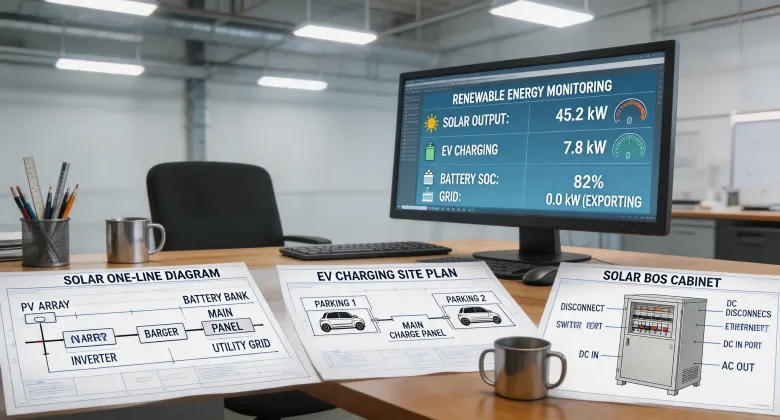
This project was a commercial solar plus battery storage system in Stevenson Ranch, CA. The solar battery storage Stevenson Ranch, CA site was about 120 kW of solar and 320 kWh of battery, with a Siemens inverter and a main switchboard that connected the battery to the building's grid feed. The client had a lease start date that was not moving, and the utility inspection date was set. If we missed it, the client would have started paying for an empty building.
The Quote Puzzle
For the 100-amp disconnect, the local distributor quoted a Siemens DTNF100: 100A, 240V, general-duty non-fusible safety switch. It was UL 98 listed and sitting on their shelf. Delivery window: 9:30 AM Tuesday, guaranteed. Total with tax and freight: $246.
The second quote came from an online seller. It was a different brand, also UL-listed, also 100A. Price: $126, shipping $42, total $168. The message from the seller said, 'Should ship by Monday.' There was also a $70 expedited processing option that would have made the total $238, so the actual gap was smaller than it looked (though not by enough to matter).
I sat on the decision for two days. The online unit was cheaper. The Siemens unit had a schedule I could trust. To be fair, the cheaper unit probably would have passed inspection. But that wasn't enough for a project with a fixed date. For a solar/battery system, the disconnect also needed to meet the disconnecting means rules in NEC Article 705, so the listing and rating mattered. Both quotes claimed that. But claim and confirmed are different.
The Moment That Mattered
I ordered the Siemens 100 amp disconnect. Not because I'm loyal to the logo, but because the distributor's delivery date was written, confirmed, and backed by a phone number I could call. On two earlier projects this year, a 'pretty sure' delivery date slipped by a week, and we ate the overtime. That hidden cost doesn't appear in any initial quote.
The Siemens unit arrived at 9:40 AM Tuesday. The electrician had it mounted before lunch. The inspector signed off on the solar battery storage Stevenson Ranch, CA system without a comment on the switchboard. The building opened on time, and I didn't have to explain a delay to a client.
There's something satisfying about watching a safety switch click into place and not thinking about it again. That kind of win doesn't show up in a P&L report, but it's real.
The Wind Detour
A few weeks later, the client asked about adding wind. That's how I fell into a research rabbit hole around Siemens wind power and the question: how many wind turbines are in America?
The simplest answer: more than 70,000 utility-scale wind turbines, according to the USGS U.S. Wind Turbine Database (accessed April 2025). Siemens Gamesa, which is the core of what you'll find when you look up 'Siemens wind power,' has supplied a big share of the global installed fleet. The scale was impressive.
But for this site, wind didn't pencil out. The average wind speed was too low, and the available space wasn't worth the structural engineering cost. So the client's renewable setup stayed as solar plus battery storage.
The Jackery That Rode Along
One side note: we keep a Jackery Explorer 3000 Pro solar generator kit in our service truck. It's a handy portable power station. During commissioning, it ran lights, a laptop, and a small compressor while the main battery was still being turned up. It's a good tool for mobile crews, but it isn't a replacement for a fixed, code-permitted storage system. Different job, different box.
The Takeaway
I don't regret paying $78 more for the Siemens disconnect. It bought a delivery date, and the delivery date protected the whole schedule. The cheap option might have worked. But 'might have worked' is not a procurement strategy.
I can only speak to commercial projects in Southern California. If you're dealing with a different utility, a different AHJ, or a homeowner-scale install, the calculus may be different. The principle still holds: the real cost of a component is the total cost of getting it into service, on time, without surprises. Prices I quoted are from March 2024; verify current pricing with your distributor.
To me, that's what total cost of ownership always meant. And this time, it meant ordering the Siemens.

Renata Silva
Renata Silva is a photovoltaic module analyst covering monocrystalline solar panels, bifacial modules, TOPCon and heterojunction designs, glass-glass construction, junction boxes, and module warranties. She interprets IEC 61215 and IEC 61730 evidence while comparing rated power, conversion efficiency, temperature coefficient, bifaciality, insulation, mechanical-load results, degradation assumptions, and tolerance. Her technical guides help EPC engineers, distributors, and project buyers separate qualification evidence from site-specific energy yield, climate exposure, installation constraints, and long-term performance risk.