The EV Charging & Solar Storage Procurement Checklist: 7 Mistakes That Ate My Margin
-
Step 1: Don't Just Buy the EV Charger; Buy the Whole System
-
Step 2: Evaluate 'Profitability' Based on Full-System Cost, Not Price Tag
-
Step 3: Plan for Supply Chain Realities (Siemens Store & Distributors)
-
Step 4: Verify Grid Connection & Interconnection Requirements (The Step Everyone Ignores)
-
Step 5: Don't Skimp on Safety Components to Save a Buck
-
Step 6: Look Beyond the Box: Transformers, Busbars, and UPS
-
Step 7: Account for Labor Efficiency & Installation Skills
-
Final Checklist & Common Mistakes
I've been handling equipment orders for renewable energy installs for about 7 years now. In that time, I've personally processed—and messed up—enough orders to total roughly $30,000 in wasted budget.
The market is changing fast. What was best practice in 2020 may not apply in 2025. Back then, we were mostly installing simple grid-tied solar. Now, I'm juggling EV chargers (like the Siemens Level 2 units), battery storage (like the Anker SOLIX C1000 + 400W panel), and complex grid interconnections. The fundamentals of electricity haven't changed in 50 years, but the execution has transformed.
This checklist is for contractors, electricians, and small business owners getting into the EV charging station business. It's split into 7 steps. Each step has a specific check point. If you do all 7, you'll avoid the mistakes I learned the hard way.
Step 1: Don't Just Buy the EV Charger; Buy the Whole System
Most people start by pricing out the EV charger itself. That's a trap. The charger is maybe 40% of the total parts cost. You also need the transformer, the disconnect switches, surge protectors, and possibly a busbar setup if you're doing multiple units.
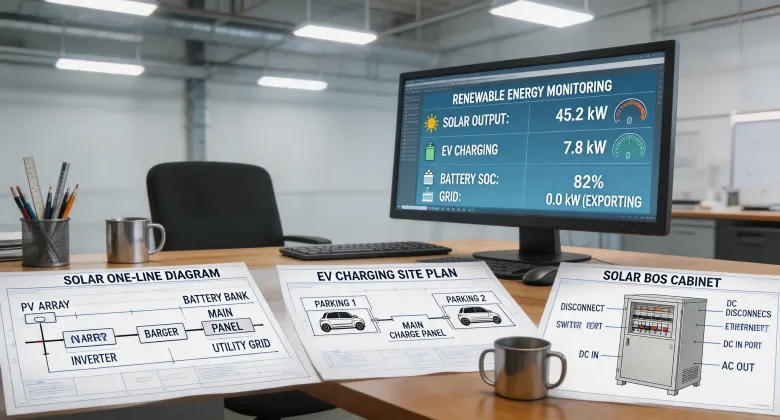
Checkpoint: Have you spec'd the balance of system (BOS) components? For a Level 2 charger install paired with storage, this includes the high voltage DC disconnect switch, conduit, and wire. When I first started in 2018, I ordered 10 chargers and zero disconnects. It cost me a 1-week delay and a $890 expedite fee. On a 10-piece order, that stung.
Step 2: Evaluate 'Profitability' Based on Full-System Cost, Not Price Tag
Everyone asks, 'Is EV charging station business profitable?' Yes, if you treat it like a construction project, not a retail purchase. Let's break it down. A Level 2 charger might be $800. The electrical panel upgrade, trenching, and permitting could be $3,000. If you're looking at fast charging, the transformer alone can be $15,000. I've seen people buy the cheapest charger and then get quoted $10,000 for the grid connection. Their profit margin vanished.
Checkpoint: Calculate the all-in cost. Per FTC guidelines, any claims you make to customers about charging speed or cost savings must be truthful and substantiated. If you tell a client it'll be $5,000 all-in, you better have the sub-panel and 200A service upgrade in that figure.
Step 3: Plan for Supply Chain Realities (Siemens Store & Distributors)
There's a reason why contractors have a Siemens store account or a similar distributor account. It's not because we love loyalty programs. It's because shipping heavy steel is expensive, and lead times vary wildly. I ordered a Siemens Level 2 charger in September 2022 thinking it'd be 2 days. It was 3 weeks. The customer was furious.
Checkpoint: Verify lead times before you quote the job. If the client needs it by the 15th, and the distributor says the 20th, quote the 20th. I can't tell you how many times a missed lead time turned a profitable job into a loss-leader.
Step 4: Verify Grid Connection & Interconnection Requirements (The Step Everyone Ignores)
This is the step everyone ignores until the end. The utility company is your biggest stakeholder, not the charger manufacturer. For a Level 2 charger, you typically just need a permit. For a battery storage system like the Anker SOLIX C1000 solar generator + 400W panel, you might need a bidirectional meter and an interconnect agreement. I once submitted an application without the utility's required 'site plan' in March 2023. It took 3 months to fix.
Checkpoint: Have you contacted the local utility about grid connection requirements before spending Capex? If a client asks about net metering or backup power, you need to know the specific rules in their district. This gets into legal compliance territory which isn't my expertise, so I'd recommend consulting your local utility or a licensed electrician for specific NEC compliance, but from a procurement standpoint: order the meter socket and disconnect in the first order, not the second.
Step 5: Don't Skimp on Safety Components to Save a Buck
Solar + storage installs have a specific requirement: a high voltage DC disconnect switch. This isn't optional. The electrical code (NEC 2023) requires a means to disconnect the DC current between the solar array, the battery, and the inverter.
The Anker SOLIX C1000 is a great portable power station, but if you're wiring it into a home or business as a fixed installation, you don't just plug it in. You need proper overcurrent protection and disconnects. I've seen people wire DC directly through a standard AC breaker. That's a fire hazard. It's tempting to think you can just compare unit prices. But a proper DC disconnect rated for 600V costs about $60. The wrong one costs your clients everything.
Checkpoint: Are you separating DC and AC systems clearly? Did you order DC-rated breakers and disconnects? I spent $1,200 on the wrong breakers in 2022 because I didn't check the voltage rating. They looked fine on the screen. They weren't.
Step 6: Look Beyond the Box: Transformers, Busbars, and UPS
If you're doing any kind of microgrid or large-scale backup, you need to look at the Siemens catalog for transformers, busbars, and UPS units. A modern transformer is more compact and efficient. Don't just install what you're used to. We're seeing more microgrids with multiple sources (solar + storage + generator + grid). That requires complex interconnects. I made a mistake in 2021 by ordering a standard distribution transformer without checking the through-fault current of the inverter. That set me back $3,000.
Checkpoint: Have you verified the load profile and fault current requirements for transformers and busbars? Don't assume the 2020 specs still apply.
Step 7: Account for Labor Efficiency & Installation Skills
Here's the part nobody in procurement talks about: labor. It takes 4 hours to install a dedicated Level 2 EV charger (like the Siemens VersiCharge). It takes 6 hours to install a solar + storage system if everything is pre-assembled. It takes 2 days if you have to fabricate brackets and wire everything from scratch.
If you're buying an Anker SOLIX C1000 + 400W panel, the installation is relatively simple. But you still need to mount the panel, run the MC4 cables, and configure the transfer switch. That takes a skilled electrician unless you're a seasoned DIYer. I'm not a licensed electrician, so I need to build trust by hiring one. The cost of that trust is passed to the client.
Checkpoint: Have you estimated labor hours accurately? A $60/hr electrician might look cheap, but if he takes 3 days, the labor is $1,440. Budget says no.
Final Checklist & Common Mistakes
Let's recap the big mistakes that kill EV charging station business profitability:
- Underestimating BOS components (transformers, disconnects, busbars).
- Quoting before verifying lead times from distributors like the Siemens store.
- Treating residential portable stations (Anker SOLIX) like commercial grid-tied assets.
- Forgetting the high voltage DC disconnect switch.
- Ignoring grid connection rules until the job is already sold.
- Basing your price on the sticker price, not the full system cost.
The industry is still maturing. Prices are changing. Technology is improving. 5 years ago, a 400W portable panel was a novelty. Today it's a standard backup solution. 10 years ago, a bidirectional EV charger was a concept. Today it's a grid asset. But some principles remain constant: check your work, verify your safety components, and never stop learning from the pain of past mistakes.

Renata Silva
Renata Silva is a photovoltaic module analyst covering monocrystalline solar panels, bifacial modules, TOPCon and heterojunction designs, glass-glass construction, junction boxes, and module warranties. She interprets IEC 61215 and IEC 61730 evidence while comparing rated power, conversion efficiency, temperature coefficient, bifaciality, insulation, mechanical-load results, degradation assumptions, and tolerance. Her technical guides help EPC engineers, distributors, and project buyers separate qualification evidence from site-specific energy yield, climate exposure, installation constraints, and long-term performance risk.