Siemens, Tesla, and Kodiak: Why Brand Reputation Is No Substitute for Procurement Verification
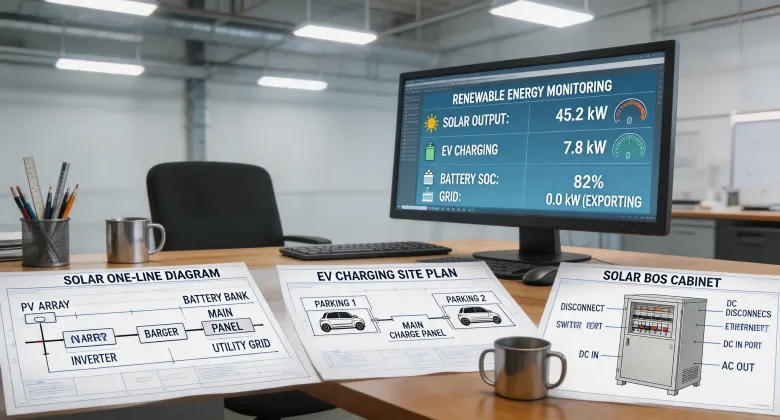
Here's my unpopular opinion: the Siemens brand is not insurance. Neither is Tesla. Neither is Kodiak. Neither is any other logo that looks good on a spec sheet. The safest thing you can buy in renewable energy is a procurement process that verifies every assumption before the PO is signed. I've been managing budgets for six years—first at a 40-person manufacturing company, now at a 120-person energy services firm. I track every invoice in our cost system, and I've negotiated with 30+ vendors. The most expensive mistakes I've seen were not the 'cheapest' products. They were trusted names that got approved without checking.
That's why I've become a prevention-over-cure convert. Five minutes of verification beats five days of correction. And with renewable energy equipment, five days of correction usually means a crane, a contractor flight, or a missed interconnection window.
Brand Reputation Is a Starting Point, Not an Ending Point
I'm not anti-brand. I've specified Siemens equipment on many projects. The Siemens brand is strong because the grid hardware is reliable, the documentation is solid, and — this matters for operations — they actually respond when something breaks. But a strong brand doesn't mean the configuration is right for your site. If you order the wrong voltage, the logo doesn't fix it. And the Siemens contact who sold the project to you might not be the person who supports you after commissioning.
In Q2 2024, a site engineer asked me to review a transformer quote from our Siemens contact. It included a 10-year warranty, and that sounded great. But when I checked the enclosure rating, it didn't meet the project's coastal corrosion spec. The brand didn't catch that. The verification checklist did. Actually, that's not completely true—the brand's technical support did help us find a corrected revision. But only because we asked.
What Cost Tracking Taught Me About Hidden Costs
When I audited our 2023 spending on solar-plus-storage equipment, I found that roughly 22% of line items had costs that weren't in the original quote. Shipping, connectors, monitoring modules, engineering stamps, interconnection paperwork. None of it was fraud. It was just absent from the initial comparison. That budget variance forced us to push a project into the next quarter.
According to Lazard's Levelized Cost of Energy Analysis (2024) — as of March 2025, at least — project economics vary more by site-specific and financing assumptions than by technology type. That matches my experience: two identical-looking solar-plus-storage bids can have a 40% difference once soft costs are included. 'Soft costs' sound small. They're not.
Take Tesla solar panel roof shingles. We evaluated them for a client because the home office wanted something visible. The shingle quote itself looked competitive, but when I added roof removal, underlayment that matches the manufacturer's spec, special flashing, conduit runs, and the cost of a certified installer, the price per watt was close to double the average for that project. That's not a condemnation of the product. It's an example of comparing the wrong line items.
When someone says a brand is expensive, I usually say no: that brand is often just more transparent about what's included. The Siemens quote for our last three-phase inverter included startup, commissioning, and a dedicated support window. Two competitive bids did not. The upfront price looked lower, but the total cost of ownership was higher. That's the difference between price analysis and cost analysis.
The Boring Question That Prevents Expensive Mistakes
One of the most valuable questions I ask suppliers is: how does a solar generator work? I'm not embarrassed to ask it in a B2B procurement call. If your team doesn't understand the basic architecture, you're buying multiple expensive components without understanding where they fail.
The short version: solar panels produce DC power. A charge controller regulates that power. A battery stores it. An inverter converts the stored DC into AC for loads. And a battery management system keeps the chemistry safe. The expensive failure points are the inverter and the battery, not the panel. So when you look at a solar generator — or a microgrid proposal — spend your due diligence where the risk is. Ask about inverter cooling in your climate. Ask about battery thermal limits. Ask about replacement cost in year eight, not just the warranty in year one.
This works for wind too. When I had to assess Kodiak wind turbines for a remote site, the initial quote looked reasonable. The red flag was service logistics. Kodiak wind turbines might be perfectly engineered, but the nearest certified technician was eleven hours away. A blade inspection would need a crane round-trip and two nights of labor. The real cost had almost nothing to do with the turbine price. It was the distance. We can't prevent every mechanical failure, but we can prevent buying equipment we can't afford to maintain.
The Objection: We Have a Siemens Contact Who Handles This
I hear this in almost every procurement review. 'We don't need to check that — our Siemens contact handles it.' I get it. My Siemens contact is genuinely responsive. But a good contact is a source of information, not a replacement for verification. If you rely on a sales engineer to catch every spec issue, you're transferring procurement responsibility to someone whose job is to sell you something.
One time, I had two hours to confirm a vendor list before an executive deadline. Normally, I'd want three quotes and a technical review. There was no time. I approved a reputable vendor without checking their compatibility requirements. In hindsight, I should have pushed back on the timeline. We didn't lose money on that project, but we spent five weeks on interoperability fixes. The post-decision doubt was real. I kept asking myself: why didn't I ask for one more day? That rush taught me that prevention is not just a technical practice; it's a scheduling practice.
Checklists Are the Cheapest Insurance
Prevention doesn't mean inspecting every bolt. It means building a short checklist that catches the expensive recurring issues. Mine looks roughly like this:
- Does the quote include all balance-of-system components for this specific site?
- Is the warranty tied to the seller, the manufacturer, or the entire system?
- Who performs O&M, and what does an unplanned service call actually cost?
- What is the replacement lead time for the inverter or battery, and are those parts even available?
- Are there penalties for interconnection delays, and who owns that risk?
That list has saved us an estimated $8,000 in rework since I created it. Sometimes it prevents an emergency crane rental. Sometimes it prevents ordering a transformer with the wrong enclosure rating. The most frustrating part is that these are all preventable.
Bottom line: brands are not insurance. Verification is. If you're comparing renewable energy vendors, use the brand reputation as the entry ticket, not the final approval. Ask the boring questions. Check the total cost. Get it in writing.
Whether it's Siemens, Tesla, Kodiak, or anyone else, the name on the equipment won't be present when the inverter fails at 2 pm. But a signed service agreement, a real understanding of how the system works, and a checklist that catches assumptions — those will be there.
I'll say it again: prevention is the only procurement philosophy that consistently saves money. The name on the box is just the beginning.
Renata Silva
Renata Silva is a photovoltaic module analyst covering monocrystalline solar panels, bifacial modules, TOPCon and heterojunction designs, glass-glass construction, junction boxes, and module warranties. She interprets IEC 61215 and IEC 61730 evidence while comparing rated power, conversion efficiency, temperature coefficient, bifaciality, insulation, mechanical-load results, degradation assumptions, and tolerance. Her technical guides help EPC engineers, distributors, and project buyers separate qualification evidence from site-specific energy yield, climate exposure, installation constraints, and long-term performance risk.