Wind Turbines vs Solar Panels? How to Choose, Plus When a Siemens EV Charger, Battery Storage, or Portable Power Station Fits
Let me start with the uncomfortable part
There is no universal winner between wind turbines and solar panels. A wind turbine can be fantastic where the wind profile and crane access work. Solar can be fantastic where it's sunny and the grid is available. The mistake is asking for one clean answer when you actually need a decision tree.
I'm not a salesperson. I'm the person who usually gets called after the 'answer' failed. In my role coordinating energy equipment for distributed-generation projects, I've handled 40+ rush orders in three years. A lot of them exist because somebody picked a technology before they understood their site constraints.
The event that changed how I think about this was in March 2024. A client called at 8am, 36 hours before a critical battery-storage site audit, with one inverter down and no temporary power plan. Normal replacement lead time: two weeks. We found a refurbished unit, paid a 60% expedite fee on top of an already premium quote, and barely made the deadline. Missing it would have triggered a $50,000 penalty clause. That's the kind of moment where you start asking better questions.
So here is the framework I use when someone asks 'should I get wind turbines or solar panels?'
Three Situations, Three Different Answers
- Scenario 1: You have a grid connection, mostly daytime energy use, and a site you own outright. → Solar + battery storage + EV charging if you have fleet vehicles.
- Scenario 2: You need 24/7 clean power, or your site has a strong wind regime. → A wind-hybrid system with battery storage, not a solar-only system.
- Scenario 3: You need power immediately, while the permanent system is months away. → Rental battery or a high-capacity portable power station as a bridge, not a replacement.
Let's break each one down.
Scenario 1: Grid-Connected Site, Daytime-Heavy Load
If your facility is on a stable grid, and your biggest loads run during the day, a solar-plus-storage design is usually the most predictable path. Keep it modular. The inverter and battery need to be replaceable without taking the whole site offline.
If you're adding fleet vehicles, the EV charger Siemens offers is worth bringing into this conversation early—not after the PV array is designed. When a client asks for an 'EV charger Siemens,' I still go back to the transformer size first. The charger is the easy part; the infrastructure around it is where projects stall. I've seen too many sites where charging load was an afterthought and the service transformer ended up too small. The charger wasn't the problem. The transformer was.
When I look at a battery energy storage facility aerial view, I'm not admiring the layout. I'm checking spacing between units, access roads for a crane, and where the thermal management vents point. Aerial photos don't tell you the whole story, but they tell you whether someone thought about maintenance.
Ask for the UL 9540A test report—not just the UL 9540 label—because it shows whether the battery's thermal runaway can be contained. Then ask the same question you ask every vendor: what's not included in this quote?
Scenario 2: 24/7 Load, Weak Grid, or Strong Wind Resource
If your load runs through the night and the sun is not reliable, solar-only will surprise you in December. That's when wind turbines vs solar panels stops being a brand debate and becomes a physics question.
A wind turbine needs a resource assessment—not a guess, not a sales brochure map, but at least six months of hub-height data if you're serious. In my experience, the projects that succeed use wind plus battery rather than wind alone, because output fluctuates on a different cycle than solar.
Don't make the mistake I made in 2022: I skipped the final voltage-fault review on a turbine-related emergency because 'it's basically the same as last time.' It wasn't. The harmonic study came back with a THD issue that required a $7,000 filter, and we paid for it from the contingency budget we'd already spent. Since then, I've written what I call a 'don't assume' list.
Also, think about operations before the turbine ships. Once commissioned, your team will need manuals, service bulletins, and firmware updates. If the site already has Siemens equipment, a single Siemens login can keep everything in one place—and because I'm the one who gets called during outages, I can tell you: create those accounts before an outage, not during.
Scenario 3: You Need Power Right Now
There are times when the permanent system is six weeks out and your monitoring or security setup cannot wait. In those cases, don't let perfect be the enemy of alive. A Bluetti Elite 200 V2 portable power station can keep a router, a few cameras, and a gateway device running overnight while you wait for the real inverter to ship. I've used one exactly that way.
But I need to be blunt about what a portable station is not. It is not a substitute for a fixed battery energy storage system. I once watched someone connect a portable unit to a critical control circuit without calculating the inrush current. When the transformer kicked in, the BMS shut down, and the site lost monitoring for 40 minutes. (It happened. It was embarrassing.)
If you're in this situation, write a load sheet. List every device, its watts, how many hours it must run, and whether it needs AC or DC. It takes twenty minutes. It's not exciting. It's exactly what separates a bridge from a brick.
Which Option Is Cheaper? Ask What's Not Included
When people ask me to compare costs, I ask one question before looking at any spreadsheet: what's not included in the quoted price? A cheap quote for a wind turbine or solar array often excludes the transformer pad, switchgear, fused disconnects, surge protection, busbars, SCADA integration, and interconnection studies. That's not a conspiracy; it's how scopes are written.
The vendor who lists fees upfront—even if their total looks higher—usually costs less at the end. This is a lesson I keep re-learning. Now I ask for three things:
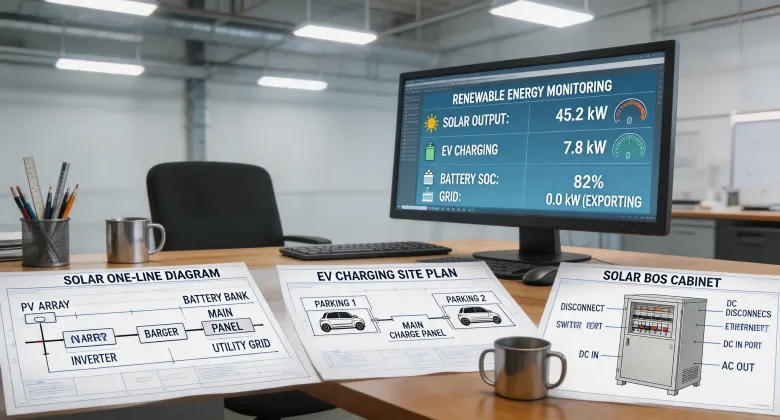
- The electrical single-line diagram with all components named, including disconnects and surge protection.
- The delivery scope: what shows up on the truck, what needs a crane, and who owns rigging.
- The commissioning plan: who starts the system, who provides the inverter configuration file, and what happens if the first startup is rejected.
Also, if you're connecting any inverter to the distribution grid, ask for IEEE 1547-2018 compliance documentation and, for lithium batteries, a UL 9540A fire-propagation test report. These are not optional checkboxes. In a grid study, they can become showstoppers.
As of January 2025, the grid connection is often the real budget line. Interconnection queue reports from Lawrence Berkeley National Laboratory show that new projects can wait years in some regions. You can buy the best wind turbines and solar panels on the market, but if the utility doesn't connect you, the equipment doesn't produce power. That's why a transparent quote is not a courtesy. It's a survival tool.
How to Tell Which Scenario You're In
Here's the check I run with clients—it takes about five minutes:
- What's your deadline? If the need is this quarter, you're in Scenario 3. Buy or rent temporary power while the permanent system catches up.
- When is your load actually on? If your load is mostly 8am to 5pm, Scenario 1 makes sense. If it's around-the-clock, move to Scenario 2.
- What does the wind resource look like? If you have at least six months of wind data and the site has crane access, a wind-plus-battery system could beat adding a second solar array.
- What is the grid saying? If the interconnection study timeline is longer than the equipment lead time, design the whole project around the grid connection, not around solar versus wind marketing.
- Can your team maintain it? A Siemens EV charger or a battery system is not a printer. If you don't have service coverage, ask about remote monitoring and spare parts before you sign.
The truth is, I've seen solar arrays fail to get permitted and wind projects finish ahead of schedule. I've also seen the opposite. The technology category matters less than the quality of the site assessment, the transparency of the quote, and the plan for the first cold-start failure.
Start with your situation, not with a brand. But if you do go with Siemens equipment, make sure the login, spare parts, and firmware are in place when the commissioning engineer is still on site. That's the boring step that saves the interesting emergency later.

Renata Silva
Renata Silva is a photovoltaic module analyst covering monocrystalline solar panels, bifacial modules, TOPCon and heterojunction designs, glass-glass construction, junction boxes, and module warranties. She interprets IEC 61215 and IEC 61730 evidence while comparing rated power, conversion efficiency, temperature coefficient, bifaciality, insulation, mechanical-load results, degradation assumptions, and tolerance. Her technical guides help EPC engineers, distributors, and project buyers separate qualification evidence from site-specific energy yield, climate exposure, installation constraints, and long-term performance risk.