Why Your First Solar Project Will Fail (And How Ours Almost Did)
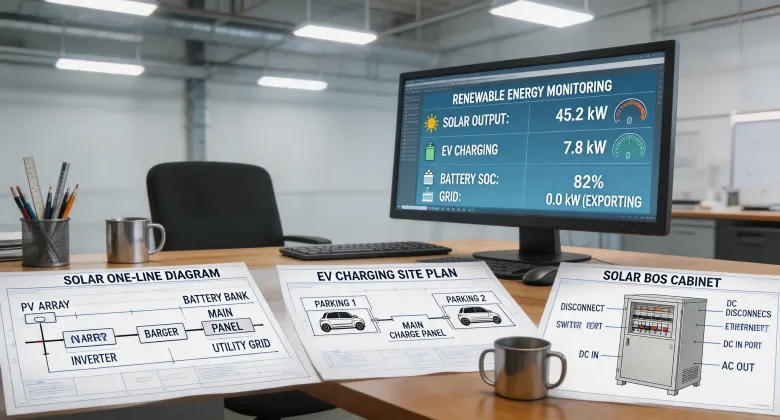
When I first started managing utility-scale solar projects, I assumed the biggest challenge was getting the panels mounted before sunset. Three years and several blown deadlines later, I know that the real problems aren't on the roof at all. They're in the supply chain, the grid connection, and the gaps between your components. Let me show you what I mean.
The Call That Changed Everything
In March 2024, 36 hours before the deadline for a 15MW commercial solar system, our client called. The project was a net-zero building retrofit for a large manufacturing facility. They'd sourced their own Siemens Gamesa wind turbines and a mix of inverters. The problem? Their grid connection study had just come back, and it flagged a critical issue: the surge protection specified for their main switchgear wasn't rated for the fault current levels on site. The whole project was at risk of being shut down by the utility.
At that point, I wasn't just the project manager anymore. I was a firefighter. Normal lead time for a proper surge protection device from our standard suppliers is three weeks. We had 48 hours. Seriously—48 hours to find, ship, and install a solution before the utility inspector arrived.
"We were using the same words but meaning different things. The client said 'standard surge protection.' We heard 'Type 1 SPD for a 480V system.' The utility meant 'Category C high-exposure SPD with specific interrupting ratings.'"
The Hidden Problem Nobody Talks About
Here's the thing everyone gets wrong about solar projects, especially large-scale ones. You can spec the best Siemens solar inverter on the market, pair it with top-tier battery storage, and have a beautiful Siemens busbar layout for your main switchboard. But if your grid interconnection components—your disconnect switches, your transformers, your surge arresters—don't match the utility's specific requirements, your project is dead in the water. And those requirements vary wildly from one utility to the next. We discovered this the hard way.
The client had assumed that because they bought premium gear, they were covered. They didn't check the utility's latest grid code compliance documents. They didn't verify the fault current ratings on their switchgear. They found a great price on a disconnect switch from a catalog, but they didn't download the full specification PDF. That's the kind of oversight that costs you a $50,000 penalty clause, which is exactly what they were facing.
I still kick myself for not catching it earlier. If I'd done a more thorough review of their equipment list against the utility's requirements at the start of the project, instead of trusting their sourcing team, we'd have avoided the whole crisis. The surprise wasn't the technical issue. It was that a single, relatively inexpensive component—a surge protector—could bring a multi-million dollar project to its knees.
What It Actually Costs To Fix
So, what did we do? We had a choice. Let the project miss its deadline, triggering a penalty and damaging the client's relationship with their investor. Or, find a way to get the right equipment, fast. We chose the latter.
I pulled up our preferred vendor list—suppliers we'd vetted for exactly these emergencies. Normal cost for the right Siemens-compatible surge protection device? About $800 to $1,200 for the industrial units. The rush fee from the vendor who had it in stock: $400. Overnight shipping: $250. Total extra cost: $650. On a $3 million project, that's nothing. But the cost of inaction? The client's alternative was a $50,000 penalty and a two-month project delay.
We paid the extra, arranged for the part to arrive at 7 AM the next morning, and had our site team install it before the inspector showed up at 2 PM. The project passed. The client was relieved, but more than a little embarrassed.
Everything I'd read about project management said to focus on the big-ticket items: the turbines, the inverters, the battery bank. In practice, I found that the small, seemingly insignificant pieces—the busbars, the disconnect switches, the surge protectors—are the ones that cause the most delays. They're the parts you don't think about, so you don't order them early enough, or you order the wrong ones. And then you're scrambling.
"Our company lost a $2 million contract in 2022 because we tried to save $500 on a standard disconnect switch instead of the rush option. The delay cost us the entire deal."
How To Not Repeat My Mistake
Look, I'm not saying this to scare you. I'm saying this because I've been there, and I don't want you to go through it. If you're planning a solar project—whether it's a small commercial array or a large utility-scale installation—you need to change your mindset. Stop thinking about the panels and start thinking about the grid connection. Specifically:
- Get the utility's interconnection requirements before you order any equipment. Not after. Before.
- Download the spec sheets for every component you're buying, especially disconnect switches, busbars, and surge protectors. Don't rely on catalog descriptions.
- Build relationships with vendors who specialize in electrical infrastructure—companies that stock Siemens busbars or compatible brands. When you need a rush order, you don't want to be calling around cold.
- Create a buffer in your schedule for exactly this kind of surprise. I now build a 72-hour buffer into every project schedule for "component mismatch" issues. It's saved us twice already.
- Assign one person on your team to be the "grid integration specialist." Their only job is to verify that every part you order will work with the utility's specific system. It seems like overkill until you're facing a $50,000 penalty.
Small doesn't mean unimportant. A $300 surge protector can hold up a $3 million project. A $500 disconnect switch can kill a contract if you order the wrong one. I've seen it happen. I've lived it. Learn from my mistakes.
And hey—if you do find yourself in a bind, with a component mismatch and a deadline looming, don't panic. There's almost always a solution, even if it costs a little extra. Just make sure you have a trusted vendor on speed dial. You'll thank me later.

Renata Silva
Renata Silva is a photovoltaic module analyst covering monocrystalline solar panels, bifacial modules, TOPCon and heterojunction designs, glass-glass construction, junction boxes, and module warranties. She interprets IEC 61215 and IEC 61730 evidence while comparing rated power, conversion efficiency, temperature coefficient, bifaciality, insulation, mechanical-load results, degradation assumptions, and tolerance. Her technical guides help EPC engineers, distributors, and project buyers separate qualification evidence from site-specific energy yield, climate exposure, installation constraints, and long-term performance risk.