Why Siemens Disconnects Are the Default on My Service Trucks
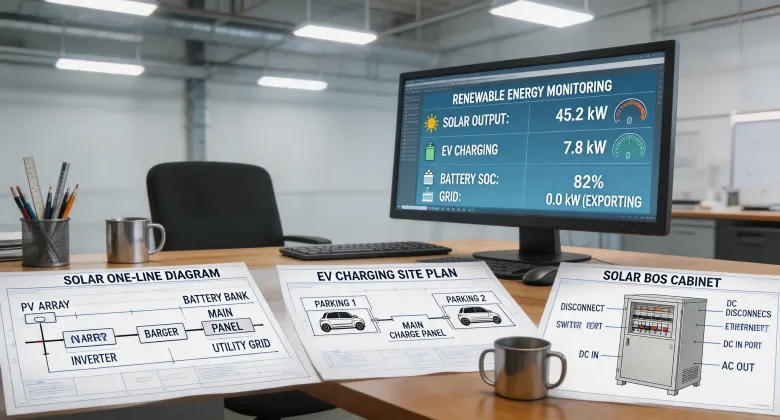
Here's the conclusion first: the most expensive repair in commercial solar isn't the one after a catastrophic failure — it's the second visit after a “temporary” fix. I've coordinated emergency service for commercial and industrial renewable-energy systems for 12 years. In that time, by our internal service log, we handled 300+ urgent callouts. 47 of those were repeat failures: systems we had already “fixed” during a previous emergency. In 38 of those 47 cases, the root cause traced back to a decision made under time pressure. The wrong part. The rushed diagnosis. The “it'll hold for now” call.
That pattern is why our service trucks carry Siemens disconnects as the default replacement for failed PV and battery disconnects. Not because the logo is pretty. Because a properly rated Siemens disconnect is the one component I haven't had to go back and replace a second time. That is the kind of boring statistic that keeps a service manager sane.
Does that mean other manufacturers make bad disconnects? No. But when an array is down and a client is losing money by the hour, I want the switch I've watched survive the worst a jobsite can throw at it. That's what the Siemens brand means to me now: fewer surprises.
Why Siemens Disconnects Are the Default on My Trucks
Ask a facility manager what failed during a solar outage and they'll blame the inverter. Ask a service tech who opened the DC disconnect and you'll get a different story. A DC disconnect (the switch that isolates the array from the inverter) is safety-critical. Under the National Electrical Code, it has to be accessible and rated for the array's DC voltage. The code doesn't specify brands, and it shouldn't. But the code is a minimum. In an emergency, the minimum is where failures live.
Here's the physics part that actually matters: DC current doesn't cross zero the way AC does. AC crosses zero 50 or 60 times per second, and each crossing gives an electrical arc a chance to go out. DC current doesn't. When you open a DC circuit under load, the arc keeps burning until the gap between the contacts is wide enough to stop it. If the switch wasn't designed and tested for DC interruption, that arc keeps burning. The result is a switch that looks fine from the outside and has welded or pitted contacts on the inside.
The disconnect that worries me most is the one installed years ago and never opened since. Contacts corrode. Mechanisms stiffen. By the time someone operates that switch under load — usually in a rush, usually during an emergency — the margin for error is gone. A well-built disconnect has margin. A cheap one doesn't. That difference doesn't show up on the shelf. It shows up in the one moment you truly need the switch. DC doesn't care about your deadline.
What the Solar PV & Energy Storage World Expo Guangzhou Taught Me About Brand Risk
In August 2024, I spent part of a morning walking the Solar PV & Energy Storage World Expo Guangzhou. I went to look at battery racks for a microgrid proposal and ended up, as usual, comparing disconnect switches. One booth had a DC disconnect that looked nearly identical to a Siemens unit we stock — same voltage class, similar enclosure, roughly 40% less cost. Maybe it was fine. Maybe it wasn't. From the outside, there was no way to tell.
That's the real lesson from the expo floor: brand is a shortcut for data you don't have time to verify. When a system is down and the clock is running, I don't have the luxury of reading forty datasheets. A manufacturer like Siemens earns that trust the slow way: through years of consistent, published performance. That's not marketing. That's risk management.
So, Can I Change My Smart Meter Back to Analog?
The question I hear more often than people expect isn't about broken hardware at all: “Can I change my smart meter back to analog?” It comes from facility managers after a billing spike and from homeowners who don't like the idea of a meter reporting their usage. My honest answer is: probably not.
If you're grid-tied and you have — or want — solar, the answer is effectively no. Net metering requires measuring energy flow in two directions: what you consume and what you export. An analog mechanical meter only measures one direction. It isn't a detail you can negotiate away; it's the difference between getting credit for exported solar and not. Utilities have also retired the manual meter-reading process that analog meters depend on. This isn't a conspiracy. It's infrastructure.
So I always ask what the analog meter is supposed to solve. If it's a billing shock, request a meter accuracy test from the utility. If it's privacy, ask your state's public utility commission whether an opt-out program exists. A few states allow it, usually with fees for manual reads. And if it's the feeling of losing control over your own energy data, the answer is not an older meter. The better answer is understanding what data the meter collects and how you can use it: rate switching, load shifting, and solar export all become possible because the meter can actually see them.
What About the Delta 3 Classic Portable Power Station?
Another recurring question in 2025: “Can we use a Delta 3 Classic portable power station as backup while we wait for a real battery system?”
It depends what you're backing up. For a router, a laptop, and a few lights, a Delta 3 Classic portable power station is genuinely useful. I keep something similar at home for that exact job. But portable power and stationary storage are not the same category.
- Motors and compressors draw several times their running wattage at startup. A portable station that looks big enough on paper can trip in the first second a refrigerator compressor kicks on.
- You cannot plug a portable station into building wiring without a listed transfer switch or interlock. Backfeeding a panel during an outage can injure a utility worker. That isn't a suggestion; it's a safety rule.
- A portable station can't export power or interact with the grid. It can't do net metering, time-of-use arbitrage, or demand response. It's a battery with outlets, not a grid asset.
The boundary I draw is simple: portable power is convenience; stationary storage is infrastructure. Use a portable station for what it's good at. If an outage means lost revenue, spoiled product, or unsafe conditions, don't buy infrastructure at a consumer-electronics price.
Where I'd Push Back on My Own Advice
For the record, I don't recommend Siemens disconnects for every project on earth. A small residential array with easy access can be perfectly fine with a less expensive UL-listed switch. If an existing disconnect is correctly rated, accessible, and opens cleanly, don't replace it just to change the label. The decision should follow the cost of failure, not brand loyalty.
But when the cost of failure is high — a commercial rooftop, a battery room, a critical facility — the cheapest component is the one you don't have to replace twice. That's the calculation that matters in an emergency. So the next time someone suggests a temporary part to get you through the weekend, ask what happens when it doesn't. From our service log, I can tell you: it's usually the second visit that hurts.

Renata Silva
Renata Silva is a photovoltaic module analyst covering monocrystalline solar panels, bifacial modules, TOPCon and heterojunction designs, glass-glass construction, junction boxes, and module warranties. She interprets IEC 61215 and IEC 61730 evidence while comparing rated power, conversion efficiency, temperature coefficient, bifaciality, insulation, mechanical-load results, degradation assumptions, and tolerance. Her technical guides help EPC engineers, distributors, and project buyers separate qualification evidence from site-specific energy yield, climate exposure, installation constraints, and long-term performance risk.