We Went All-In on Siemens for Net Zero Buildings, EV Charging, and Solar. Here's What We Learned.
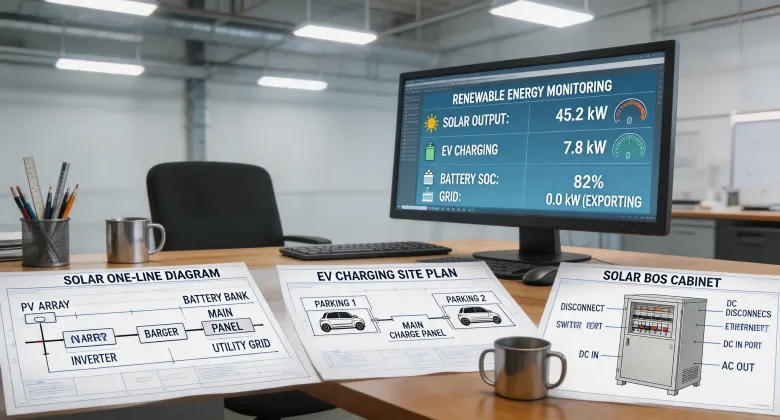
If we had to sum it up: standardizing on Siemens for our net zero building initiative, EV charging rollout, and solar backup system was the right call—but not for the reasons the sales brochures tell you.
The brochures talk about efficiency gains, synergy, and future-proofing. For us, an office of about 200 people across two locations, the real reason was simpler: we needed one throat to choke, and we needed equipment that wouldn't make our facilities manager (that's me, by the way, with a side of procurement) look like a fool when something went wrong. And things do go wrong.
This isn't a review. It's a reality check based on onboarding a Siemens EV charging station, integrating their solar inverter with our battery storage, and trying to hit a net zero target for a building that was built in 1987.
The Trigger: Two Vendors, One Parking Lot Disaster
I wasn't always a Siemens fan. Before 2023, I was perfectly happy mixing and matching. We had a generic Level 2 charger from a startup, some random brand of solar panel fuse (don't ask), and a battery system that spoke its own language. The setup worked, mostly. Until it didn't.
In August 2023, we had a power dip. The battery system kicked in, but the EV charger didn't re-sync with the solar inverter. The car was plugged in, drawing power from the grid at peak rates, while our solar panels were exporting excess energy back. My boss, the VP of Operations, got a notification from our energy management software. A very angry notification. We had essentially been paying to charge a car with expensive grid power while giving away free solar power.
That was the trigger. The interconnectivity was a mess. We had three different apps, two login portals, and no one to call who could fix the whole thing.
It's tempting to think you can just buy the 'best in class' from each category. But the 'always buy the cheapest component' advice ignores the cost of integration, troubleshooting, and the finger-pointing that happens when A blames B and B blames C.
Why Siemens? The Time-Certainty Premium
We looked at other options—GE, Schneider, even separate setups from different vendors. But the deciding factor wasn't the specs on paper. It was the timeline.
Our net zero building certification deadline was fixed. No extensions. If we didn't hit the energy reduction target by July 2024, we'd lose a tax incentive worth roughly $35,000.
People think expensive vendors deliver better quality. Actually, vendors who deliver quality can charge more because they can guarantee the timeline. The assumption is rush orders cost more because they're harder. The reality is they cost more because they're unpredictable and disrupt planned workflows.
Siemens wasn't the cheapest. Their quote for the full package—EV chargers, solar inverter, battery management, and grid interface—was about 18% more than the budget DIY route. But their project manager gave us a single, fixed delivery date. Not a 'two to four weeks, maybe' estimate. A specific day. That was worth the premium.
"In March 2024, we paid $400 extra for rush delivery on a specific component. The alternative was missing a $15,000 certification deadline. The math was simple."
The Surprising Thing About 'Car Solar Panel Charger' Integration
One of the things I had to research was how a car solar panel charger setup would work with our existing infrastructure. You'd think it's just plug and play. It's not.
Forget the hype about powering your car directly from the panels on your roof. For a commercial setup, that's rarely efficient unless you have DC-coupled everything. What we actually needed was a smart inverter that could prioritize. We use the Siemens solar inverter. When the sun is shining, it routes power first to the building's base load, then to the battery storage, and only exports to the grid if the batteries are full.
The EV charging station—a Siemens VersiCharge, if you're wondering—is integrated into this hierarchy. It draws from the battery, not the grid, when solar is low. This isn't a feature you get from a cheap inverter. It requires an energy management system that can talk to everything. Siemens' platform does this. It's not perfect, but it's the only one I've used that doesn't require a PhD in electrical engineering to set up.
We also had to spec out a solar panel fuse for the array. I'm an administrator, not an electrician, but I learned this: don't cheap out on the fuse. I wanted to buy a standard DC fuse from an online supply house ($15). Our installer said use the Siemens-spec'd inline fuse holder ($45).
I only believed this advice after ignoring it on a smaller sub-panel and having a fuse fail catastrophically, taking out four panels for a week while we sourced the right replacement.
Take this with a grain of salt, but my rule of thumb now is: protection and switching components are not the place to save money.
How Much Electricity Can Wind Turbines Produce? (The Context Question)
I also had a stakeholder ask me: "How much electricity can wind turbines produce?" We weren't installing a turbine (our site is terrible for wind), but it came up in the context of our overall net zero strategy.
It's an important question because it highlights the 'boundary conditions' of our setup. Siemens makes massive wind turbines (through Siemens Gamesa), but those are for utility companies. The general answer is: a modern 2-3 MW turbine can power roughly 1,500 average EU homes for a year. But for a building like ours, that question is irrelevant. The answer for our context was: 'Zero, because we're not installing one.'
This helped frame our entire strategy. We weren't trying to generate all our power. We were trying to reduce consumption and manage what we did generate better. The Siemens energy management system is really just a sophisticated shunting device. It makes sure you use your own power first.
The Boundary Conditions: What I'd Do Differently
So, is a Siemens-standardized setup the answer for everyone? No. At least, that's been my experience with commercial buildings that have a dedicated facilities team.
If we were a smaller company, say 10 people, the integration cost wouldn't be worth it. You could use a simple EV charger and a standard solar inverter and be fine. The complexity of the Siemens system requires a learning curve. I still find myself calling support for issues I probably could solve myself if I read the manual more carefully.
Also, the dependency is real. If Siemens has a supply chain hiccup (which happened with one of the busbar components for our switchgear), you can't just sub in a competitor's part. You're locked in.
One of my biggest regrets: not negotiating a longer initial support contract. We got a fantastic price on the hardware, but the first year of premium support was an add-on that we later renewed at a higher rate. If I'd baked it into the initial quote, I'd have saved about $1,200.
The Bottom Line Verdict
I still kick myself for not doing the integration audit earlier. If I'd mapped out all the sub-systems in 2022, we could have avoided the peak-rate disaster.
The final result? Our net zero building certification passed. Our electricity bill dropped by about 22% year-over-year. The EV charging is free for employees during solar hours. And when I call our Siemens rep, they know who I am and what we have.
If you're managing a similar project and are under a tight deadline, pay the premium for the integrated solution. The price of being wrong—a missed certification, angry executives, or a fried solar panel fuse—dwarfs the cost of getting it right.

Renata Silva
Renata Silva is a photovoltaic module analyst covering monocrystalline solar panels, bifacial modules, TOPCon and heterojunction designs, glass-glass construction, junction boxes, and module warranties. She interprets IEC 61215 and IEC 61730 evidence while comparing rated power, conversion efficiency, temperature coefficient, bifaciality, insulation, mechanical-load results, degradation assumptions, and tolerance. Her technical guides help EPC engineers, distributors, and project buyers separate qualification evidence from site-specific energy yield, climate exposure, installation constraints, and long-term performance risk.