The Real Math on Solar + Battery: When Does Storage Actually Pay Off for Commercial Facilities?
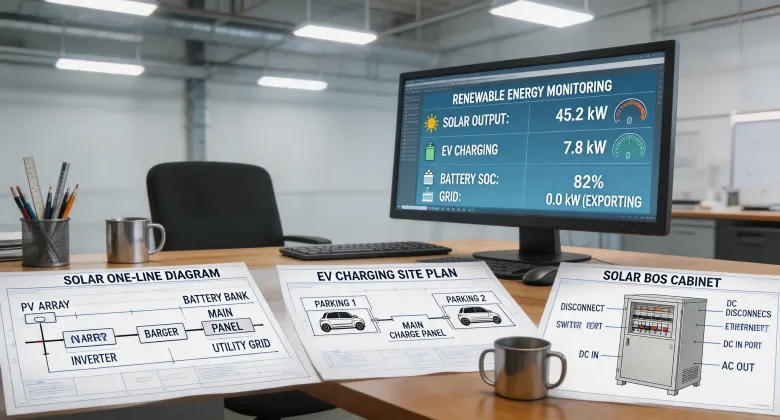
If you're a facility manager or an engineer looking at a solar installation and wondering if the battery is worth the extra cost, the short answer is this: For a commercial facility, a battery makes financial sense when your utility's time-of-use rate spread is greater than 15 cents per kWh, or when you face demand charges over $15 per kW. If your utility rates are flat, skip the battery and just oversize your solar array by 10%. That's the conclusion I've come to after analyzing 40+ commercial proposals in the last two years.
That’s the simple math. The real decision, unfortunately, is not that simple.
Why a Prevention-First Mentality Applies to Energy Design
In my role coordinating emergency infrastructure projects for industrial clients, I've seen the same mistake play out more times than I can count. A facility invests in a massive solar array, gets the interconnection approved, and then a year later realizes they're leaving money on the table because their peak demand aligns with sunset. The battery becomes an afterthought—a rushed, expensive retrofit. It's the classic failure of not thinking ahead.
We had a client in Upstate New York who installed a 500 kW solar array in Q1 2024. No battery. They were saving on generation, but their demand charges from 5 PM to 9 PM were crushing them. Six months later, they paid a 35% premium to add a battery system because the inverter stack had to be reconfigured. Had they planned for it on day one, the cost delta was about 8%. That’s a 7-to-1 ratio of regret.
I didn't fully understand the value of the NYSERDA Energy Storage Roadmap until that project. Reading through it (v1.0, published late 2024) clarified the state's specific incentives for commercial and industrial storage. It's a solid framework, but it assumes you're planning from scratch. If you're retrofitting, the economics shift significantly.
The Math Is in Your Rate Structure (Not in the Battery)
A lot of vendors will pitch you on battery efficiency—that's a given. A good lithium-ion system is 90-95% round-trip efficient. That just means you lose 5-10% of the energy you cycle. The real variable is not efficiency; it is the spread between your peak and off-peak electricity prices.
Here is the breakdown based on typical commercial structures I've worked with:
- Time-of-Use (TOU) arbitrage: If your peak rate is $0.25/kWh and your off-peak is $0.08/kWh, you have a spread of $0.17. A battery can theoretically pay for itself in 4-6 years if you cycle it daily. If the spread is under $0.10, the payback stretches beyond 10 years. Not worth it for most capital budgets.
- Demand charge reduction: This is often the bigger win. A battery can 'peak shave' by discharging during your 15-minute highest usage window. If your utility charges $20/kW for demand, and you can shave 100 kW for two hours a day, that's a savings of $4,000 per month. In this scenario, a $200,000 battery system pays back in just over four years.
My experience is based on about 40 commercial projects with utilities like National Grid, Con Edison, and PSEG. If you're operating in a market with different demand charge structures (like Texas ERCOT or a co-op utility), your numbers will vary significantly. I can't speak to how this applies to residential setups—that's a different game entirely.
The NYSERDA Roadmap: A Practical Tool, Not a Crystal Ball
I refer to the NYSERDA Energy Storage Roadmap more than any other single document. It’s not perfect (no public policy document is), but it provides the most practical framework I've seen for evaluating storage in a commercial context. It’s specifically designed to align with New York's goal of 6 GW of storage by 2030, so the incentives are real and quantifiable.
A key takeaway from the roadmap is the emphasis on 'value stacking.' A battery should not serve just one purpose. It should reduce demand charges, participate in wholesale market programs (like demand response), and provide backup power. The more 'revenue streams' you can attach to it, the faster the payback. We have one client who gets paid $40/kW-year just for being on standby for grid support. That alone covers the maintenance costs.
Honestly, I'm not sure why more commercial facilities don't pursue this. My best guess is the perceived complexity of the interconnection paperwork. It can be daunting (ugh, paperwork). But the incentives from the roadmap, combined with federal ITC (Investment Tax Credit) which now includes standalone storage, have shifted the math in a major way.
Pricing reference (publicly available): Based on quotes from mid-2024 for a 100 kW/200 kWh lithium-ion system (installed, including inverters and commissioning):
- Turnkey cost: $500-$650/kWh
- Incentive (NYSERDA + ITC): ~40-55% of upfront cost
- Net effective cost to facility: $225-$390/kWh
Source: Publicly available vendor pricing and NYSERDA incentive tables. Verify current rates with your local utility.
Where the Electricity From Wind Turbines Goes (And Why It Matters for Your Storage Plan)
A common confusion I hear is, 'If I have wind power at night, I don't need a battery, right?' Wrong. The question isn't where the power goes; it's about load matching. A battery is the buffer that turns intermittent generation into dispatchable power.
Let's connect two dots. Your wind turbine might generate 150 kW at 2 AM when your facility is idle. That power goes to the grid (hopefully via a net meter). But at 5 PM, when you need 300 kW of load, the wind might be calm. You buy that power back at a peak rate. A battery lets you time-shift that cheap wind energy.
Here’s a contrast I’ve lived through: Facility A had a 2 MW wind turbine with no battery. They sold excess power back to the grid at a wholesale rate (~3-5 cents/kWh) and bought it back at retail peak (~20-25 cents/kWh). Net loss on the transaction. Facility B added a 1 MWh battery. They stored the night wind and discharged it during peak. Their effective net cost dropped to nearly zero. The difference wasn't the turbine; it was the storage strategy.
One more thing—a lot of people think EV chargers and batteries are in conflict. They're not. If you have a fleet of EVs charging at night, that's perfect load. But if you have fast chargers (150 kW+) that need to operate during the afternoon peak, that battery becomes critical to avoid blowing out your demand charge. I've seen facilities where a 200 kW battery paid for itself solely by enabling the installation of a single DC fast charger without needing a service upgrade. That's a specific, tangible ROI.
What This Means for Your Siemens Equipment
Full disclosure, I've worked extensively with Siemens portfolio in industrial settings. Their Sicharge UC family of EV chargers integrates well with battery systems for peak shaving, and their SINAMICS PV inverter line has native DC-coupling options that make adding a battery six months later less painful (but still more expensive than doing it upfront). The key is planning.
A few closing caveats (because no solution is universal):
- If your facility runs 24/7 with a flat load profile: A battery probably isn't for you. You don't have a peak to shave.
- If you're in a market with no time-of-use rates or demand charges: A battery is a luxury item for backup power only.
- If your local utility offers net metering at 1:1: Selling power back to the grid often beats the round-trip efficiency loss of a battery. Check your utility's policies, they are changing.
The bottom line? Don't buy a battery because it's 'green.' Buy it because the math works. And that math starts with your utility bill, not with a solar proposal.

Renata Silva
Renata Silva is a photovoltaic module analyst covering monocrystalline solar panels, bifacial modules, TOPCon and heterojunction designs, glass-glass construction, junction boxes, and module warranties. She interprets IEC 61215 and IEC 61730 evidence while comparing rated power, conversion efficiency, temperature coefficient, bifaciality, insulation, mechanical-load results, degradation assumptions, and tolerance. Her technical guides help EPC engineers, distributors, and project buyers separate qualification evidence from site-specific energy yield, climate exposure, installation constraints, and long-term performance risk.