Siemens Solar Panels? 60A Disconnect, Edecoa Inverters, and Surge Protection Explained
If you've ever typed "siemens solar panels" into a search bar at 11pm, you know that strange mix of hope and confusion. I've been there. I'm a purchasing coordinator who handles renewable-energy equipment orders—mostly US commercial solar and small off-grid builds. In the last eight years, I've personally made (and documented) six significant mistakes totaling roughly $14,000 in wasted budget. Not exactly the résumé section I put first, but it's why I keep a checklist instead of trusting my instincts.
So here's the thing: there is no single "best" solar-equipment setup. The right answer depends on whether you're wiring a permitted roof array, throwing together a trailer for job-site tools, or just trying not to kill your laptop with a bad power strip. Let's walk through three scenarios.
- Scenario A: Grid-tied solar and electrical service. You care about inspectors, code, and part numbers.
- Scenario B: Off-grid / portable power. You're reading inverter and solar generator reviews, and budget matters.
- Scenario C: Sensitive electronics. You're deciding between a grounded power strip and a surge protector.
Scenario A: What to Do With the Search "Siemens Solar Panels"
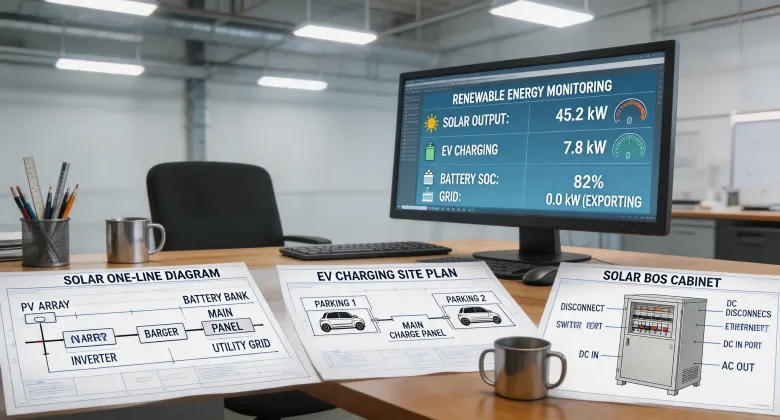
First, let's clear up a misconception. From the outside, it looks like "Siemens solar panels" should be a product line you can spec, like their wind turbines or switchgear. The reality is a little different. In the US residential and commercial PV market, as of my last check in early 2025, Siemens isn't selling a branded panel module under that name. What Siemens actually makes for a solar installation is the stuff around the panels: solar inverters, battery storage, EV chargers, transformers, disconnects, surge protectors, and microgrid gear.
I made the same assumption when I started. I called a rep asking for Siemens module part numbers and got a very polite laugh. The lesson: if someone quotes you "Siemens solar panels," ask them for the specific part number. If they can't provide one, they're probably describing a system that combines Siemens electrical equipment with panels from another manufacturer. That's not a red flag—it's actually normal. But you need to know what you're paying for.
When a Siemens 60 Amp Disconnect Is the Right Choice
In my experience, you buy a Siemens 60 amp disconnect when the inverter or combiner nameplate calls for a 60A AC disconnect. The box with the heavy handle looks simple, but don't let the simplicity fool you. From the outside, it looks like a light switch. The reality is that a listed disconnect has to handle available fault current, match the voltage, and fit the conductor properly. I once approved a batch of 60A switches without checking the inverter's max overcurrent rating. The inspector rejected them—six units, $2,100, one week of delay. The irony? I was trying to save time by ordering one model for everything.
So if you're in Scenario A: buy the disconnect that matches the inverter's spec sheet, not the one that "looks heavy enough." And if a seller lists "Siemens solar panels," keep drilling until you get the inverter, disconnect, and monitoring details. Trust me on this one.
Scenario B: Edecoa Power Inverter and Project Solar Generator Reviews
Scenario B is the world I probably spend the most time in now. You're building a job-site solar generator, a trailer, or an emergency power box. You search "Edecoa power inverter" because it's cheap, and then you read project solar generator reviews to decide whether it's a trap.
Here's my honest take, with sample-size warnings included: I don't have hard data on Edecoa's long-term failure rate. My experience is limited to a batch of 12 units we used for light-duty 12V trailer builds. Three had issues within the first six months. That's not a peer-reviewed study—it's one buyer's anecdote. Your experience might be completely different.
What I can tell you is that a cheap power inverter is a reasonable decision if you understand what you're buying. Use it for a phone charger, a laptop, a small fan, or a drill battery station. Don't use it for a sump pump, a medical device, a freezer, or anything where "off for a week" is not acceptable. The cost difference between Edecoa and a heavier-duty inverter is basically the price of a backup plan.
And when you're reading project solar generator reviews, separate the equipment from the experience. I've seen a review complain about a bad charge controller, then blame the "solar generator" as a whole. That's like blaming a car because the tires were worn. Look for reviewers who state the exact loads they ran, the weather, and how long it lasted. Reviews that just say "great for camping" are useless.
Also, small buyer point: don't let a small order make you feel like you don't deserve technical support. When I started, I bought three units from a distributor who ignored my questions. I lost maybe $200. I now send thousands of dollars a year to suppliers who answered those same questions when I was nobody. Small doesn't mean unimportant—it means potential.
Scenario C: Grounded Power Strip vs Surge Protector: The Real Difference
This one is simple but people get it wrong all the time. A grounded power strip is just extra outlets with a breaker. It does not protect your electronics from voltage spikes. A surge protector—the kind with the UL 1449 mark—has a component that clamps down on high voltage. Per FTC guidance (ftc.gov), advertising claims have to be truthful and substantiated, so the word "surge" on the box matters. But the box also needs to say "UL 1449" or you're probably paying for nothing.
The part that surprises people: a surge protector is not always better. For high-current loads like a space heater, laser printer, or mini fridge, a cheap surge protector can become a weak point. The material inside degrades every time it absorbs a surge, and a small unit can fail in a way that starts with a warm plug. For those loads, use a dedicated wall outlet or a heavy-duty rated strip—not a $15 surge protector pretending to be a power distribution unit.
For a laptop, network gear, DVR, or TV? Yes, use a surge protector. Ideally a whole-panel surge protector at the electrical panel plus a point-of-use strip. What a plug-in strip can't do is guard against a surge coming through coax or Ethernet. If your cable line is involved, get one with coax/network protection or disconnect those lines when you're away.
My rookie mistake in this category: I once plugged a laser printer and a UPS into the same surge protector. The UPS beeped, the printer spooled, and the surge protector clicked off under the combined current. I thought I'd protected everything; I had actually created a mini breaker panel that didn't want to cooperate. The real fix was putting the printer on a plain outlet and the UPS on its own surge protector.
How to Tell Which Scenario You're In
If you have a permit, an inspector, or a utility interconnection agreement, you're in Scenario A. Stop reading reviews, look at spec sheets, and ask for part numbers. The 60A disconnect question should be answered by the inverter's label, not by a forum.
If you're building a portable power station, trailer, or emergency box, you're in Scenario B. Budget is real, but so is the cost of a failed unit. Match the inverter to the worst-case load, not the average. Buy a backup if you need it. And read reviews like a detective.
If you just want to keep your computer alive during a storm, you're in Scenario C. Buy a surge protector with UL 1449 and enough joule rating for your area. If the product description says "power strip" and nothing else, treat it as a power strip.
My experience is based on North American projects of small-to-medium size. If you're outside that world, your codes and product availability will differ—take this guide with a grain of salt. But the core lesson is universal: know what problem you're solving before you buy the gear. I've made expensive mistakes so you don't have to.

Renata Silva
Renata Silva is a photovoltaic module analyst covering monocrystalline solar panels, bifacial modules, TOPCon and heterojunction designs, glass-glass construction, junction boxes, and module warranties. She interprets IEC 61215 and IEC 61730 evidence while comparing rated power, conversion efficiency, temperature coefficient, bifaciality, insulation, mechanical-load results, degradation assumptions, and tolerance. Her technical guides help EPC engineers, distributors, and project buyers separate qualification evidence from site-specific energy yield, climate exposure, installation constraints, and long-term performance risk.