Siemens Portal, Solar Monitors, Hybrid Storage, and EV Chargers: Which Scenario Are You In?
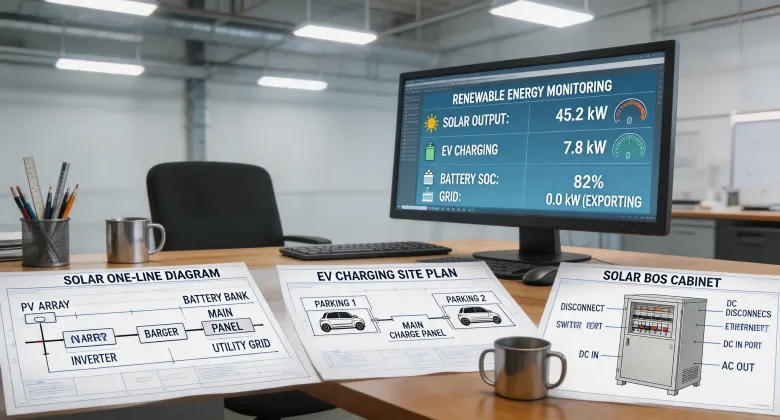
I have been handling renewable energy procurement orders for 9 years. I have personally made and documented 7 significant mistakes, totaling roughly $42,000 in wasted budget. Now I maintain our team checklist to stop others from repeating my errors.
Look, there is no single answer to the question: what renewable energy setup should I buy? It depends. The right choice for a 12-site industrial portfolio is wrong for a single warehouse with one EV charger. So here is how I break it down into four scenarios.
The question is not what is the best product. The question is what problem are you actually solving. Monitoring? Charging? Resilience? Or multi-site control? I have messed up all four.
Scenario A: You have solar but no visibility
If your solar arrays are running but you cannot see what they produce, start with monitoring. A solar energy monitor is the cheapest way to catch underperformance. But most buyers focus on panel wattage and completely miss monitoring protocol compatibility.
In my first year, 2017, I bought 12 solar energy monitors without checking if they spoke Modbus TCP or SunSpec. They did not. The result was $2,400 in monitors that could not talk to our inverters. That was the reverse validation I needed. Everyone told me to check specs first. I only believed it after eating that mistake.
In 2019, I ordered 18 monitors for a retail chain. I checked voltage and CT size. I did not check if they had a local API. The vendor locked data behind a subscription. We ended up paying $1,100 extra per year just to get the data out. That was not in the quote.
The question everyone asks is what is your price per monitor? The question they should ask is what is your data access policy?
What should you check? Ask about protocol, CT rating, sample rate, and API access. If you have a small office or home setup, the Siemens Inhab smart home energy monitor can be enough. If you have multiple sites, Siemens Portal gives you one dashboard for fleet-level data.
Why does this matter? Because a monitor that cannot export data to your portal is just a wall decoration.
Per FTC Green Guides (ftc.gov), environmental claims must be substantiated. A claim like 100% renewable needs evidence behind it. Ask the vendor for the backup.
Scenario B: You only need EV charging
Can I buy an EV charging station? Yes, you can. But the charger is the easy part. The expensive part is the electrical work, permits, and load management.
In September 2022, we installed four chargers at a warehouse without a load calculation. We assumed the panel had spare capacity. It did not. That error cost $6,800 in a service upgrade plus a 1-week delay. The chargers worked. The site did not.
We once ordered 6 chargers before the utility approved the service upgrade. They sat in the warehouse for 4 months. That tied up $9,000 in capital. Not a disaster, but annoying.
Here is the thing: if you have spare capacity, buy the chargers and move on. If you do not, you have two paths. Add load management, or upgrade the service. Load management is usually cheaper. But it depends on your utility rules.
Check: panel capacity, transformer size, wire run distance, ADA requirements, network connectivity, payment system, and utility rebates. Miss one of these and you will pay for it later.
Scope limiting: that advice is for commercial sites with existing electrical infrastructure. If you are a homeowner buying one charger for a garage, a basic unit is often fine.
Scenario C: You need resilience or peak shaving
If you are tired of demand charges or need backup power, you are in hybrid storage territory. This is where a hybrid energy storage system factory comes in. But sourcing from a factory is not like buying a monitor.
In Q1 2021, I ordered a hybrid storage system from a factory without confirming BMS communication. The battery racks arrived. They were beautiful. They also could not talk to our power conversion system. We spent $12,000 on integration and still lost three weeks. I want to say the total was $12,000, but don't quote me on that. It was expensive.
I once visited a factory that claimed they could do inverters, batteries, and EMS. Their battery test reports were from 2018. That was another red flag. We walked away.
What should you ask a hybrid energy storage system factory? Ask about cell chemistry, BMS protocol, UL 9540 or IEC 62619 certification, warranty terms, MOQ, and lead time. If they say they do everything, that is a red flag. A factory that says we build the racks and DC blocks, but you need a separate PCS integrator is more trustworthy.
The vendor who said this is not our strength, here is who does it better earned my trust for everything else. I would rather work with a specialist who knows their limits than a generalist who overpromises.
Cost reality: we budgeted $45,000 for a 100 kWh system. The final landed cost was $58,000 after shipping, duties, and integration. That 29% overrun was my fault for not asking about Incoterms.
Scenario D: You have multiple sites and need one pane of glass
If you are managing more than three sites, monitoring becomes a data problem. You do not need another dashboard. You need one dashboard. That is where Siemens Portal can help. It can centralize data from solar, storage, and EV chargers.
We tried to manage 14 sites with separate vendor dashboards. In 2023, a fault at one site went unnoticed for 3 days. The demand charges hit $4,200. After that, we created a pre-check list for portal compatibility.
Siemens Portal can be powerful. But it is not free. There is usually a license or subscription. Factor that in. We saved maybe $9,000 annually in avoided demand charges, but don't quote me on that. The portal fee was around $2,500 per year.
If you have 3 sites, a spreadsheet might be enough. If you have 30, you need a portal.
Bottom line: Siemens Portal is not a magic fix. It is a tool. It only works if your devices can talk to it. So check device compatibility before you buy. That is a no-brainer, but I learned it the hard way.
How to know which scenario you are in
Ask yourself these questions:
- Do you already have solar? If yes and you lack data, go to Scenario A.
- Do you only need EV charging? If yes, go to Scenario B.
- Do you need backup or peak shaving? If yes, go to Scenario C.
- Do you have multiple sites? If yes, go to Scenario D.
If you are on the fence between two scenarios, pick the one that solves the most expensive problem first. Monitoring is cheap. Downtime is not.
And remember the expertise boundary. A good supplier will tell you what they do not do. A bad one will say yes to everything. The same goes for your own team. You do not have to be an expert in all four scenarios. You just need to know which one you are in.
Prices and regulations change. Verify current rates and rules before you buy. For environmental claims, check the FTC Green Guides at ftc.gov.

Renata Silva
Renata Silva is a photovoltaic module analyst covering monocrystalline solar panels, bifacial modules, TOPCon and heterojunction designs, glass-glass construction, junction boxes, and module warranties. She interprets IEC 61215 and IEC 61730 evidence while comparing rated power, conversion efficiency, temperature coefficient, bifaciality, insulation, mechanical-load results, degradation assumptions, and tolerance. Her technical guides help EPC engineers, distributors, and project buyers separate qualification evidence from site-specific energy yield, climate exposure, installation constraints, and long-term performance risk.