Siemens EV Chargers: A Cost Controller's 8-Year TCO Breakdown (2025)
Straight to the conclusion: Siemens EV chargers are almost never the lowest quote in a commercial tender. In our Q3 2024 bidding for 20 AC charging ports, the Siemens option cost $560 more per port than the cheapest alternative. Over an eight-year cost model, it ended up about $1,400 per port cheaper. If you're comparing chargers purely on unit price, you're probably comparing the wrong numbers.
For context: I'm a procurement manager at a 95-person logistics company in Ohio. EV charging infrastructure has been part of my budget since 2021—roughly $146,000 per year across two depots. I've tracked every invoice, negotiated with more than 15 vendors, and built a TCO spreadsheet that has embarrassed more than one sales rep.
I didn't start out with this opinion. When I first began buying chargers, I assumed hardware was hardware: certification is certification, and the cheapest unit would charge cars just as well as a premium one. The trigger event came in March 2023. We installed 12 budget Level 2 chargers at a satellite depot to save about $180 per unit. The commissioning was a mess, two units failed within the first month, and the savings disappeared into electricians' invoices and my own lost hours. Worse than expected—and a lesson learned the hard way.
Look, I'm not saying premium hardware is always worth it. But what was best practice in 2020 is not best practice in 2025. Five years ago, a charger was a dumb box with a cable. Now, with time-of-use rates, demand charges, and fleet scheduling, load management and software integration are where the financial value lives. The fundamentals of electrical work haven't changed; the buying decision has transformed.
What Actually Costs Money in a Commercial EV Charger
Here's something vendors won't tell you: the unit price is usually a minority of what you'll spend over the equipment's life. In our tracking, the real cost categories are:
- Hardware — the charger itself. Usually 25–40% of installed cost for AC units, and a smaller share for DC.
- Installation and electrical work — panels, conduit, load management, permits, labor. This is where quotes diverge most, and where cheap hardware often creates expensive problems.
- Software and networking — the hidden one. Some vendors require a cloud subscription just to enable scheduling or load management. At $10–$20 per charger per month, that translates to $19,000–$38,000 over eight years on a 20-port site.
- Maintenance and failures — warranty labor, replacements, connector wear, downtime.
- Electricity cost structure — demand charges and time-of-use rates. A charger with intelligent load management can shift load and reduce this, which is often the largest line item of all.
If you compare only the first line, you're not comparing costs. You're comparing price tags.
The Q3 2024 Tender That Changed Our Vendor List
Full disclosure: the exercise below isn't unique to our company. If you're considering an EV charger Siemens has quoted for your own site, the pattern will look familiar.
Last fall, we went to market for 20 AC charging ports at our Columbus depot. We asked for fully installed pricing and a breakdown of recurring fees over eight years. The lowest bid came in at $2,180 per port fully installed. Siemens quoted $2,740 per port. That $560 gap per port—$11,200 across the site—is hard to defend to a CFO who reads the first page of the budget.
The surprise wasn't the upfront price gap. It was how completely it reversed once recurring fees entered the model. The budget charger required a mandatory cloud subscription for load management—$12 per port per month, which is $1,152 per port over eight years. Based on our experience with that product class, I also budgeted one connector replacement and a service visit, roughly $720 per port. The Siemens configuration we specified did not require a recurring software subscription. The units are built for commercial duty, and in our other depots they've simply needed less attention.
The eight-year totals: about $4,150 per port for the budget option versus $2,740 per port for the Siemens. The supposedly cheap option cost 51% more by year eight. That's not a rounding error. That's the difference between an asset and a liability.
This is where the industry-evolution point matters: the older wisdom was that a certified $600 charger was functionally identical to a $1,400 one. In a world of flat electricity rates and dumb charging, that was roughly true. In a world of demand charges, smart load management, and fleet uptime requirements, it isn't. The technology changed the assumptions underneath the old advice.
DC Fast Charging Is a Separate Purchase—and a Separate Budget
For overnight AC charging, the math above applies. If your vehicles need energy during the day, DC fast charging is a different animal. We priced Siemens' SICHARGE D alongside two other DC manufacturers at the start of 2024. A 60 kW unit, installed, landed in the $25,000–$45,000 range depending on the electrical upgrade required. The SICHARGE D wasn't the cheapest quote we received—but its modular design meant we could start at one power level and expand later without replacing the cabinet. That option value is hard to quantify, but it's real. I'm not 100% sure those numbers still hold for your region; equipment pricing moves with tariffs and supply chains, so treat them as directional.
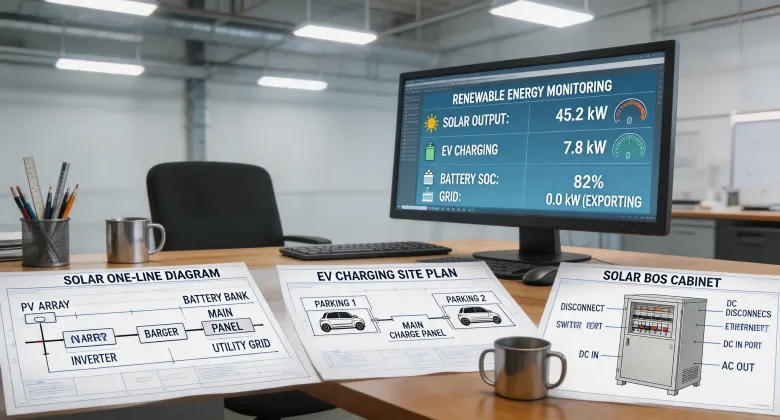
One more thing I've learned the slow way: DC chargers make sense when you combine them with on-site solar and battery storage. We eventually paired our AC fleet charging with a 150 kW rooftop array and a 90 kWh battery. Charging during solar hours instead of pulling from the grid during peak periods cut our demand charges by roughly $1,100 per month. The chargers themselves were only half the story. The system around them was the other half.
That's why, as a cost controller, I now look at the whole energy ecosystem—chargers, inverters, storage, switchgear—rather than treating each piece as a standalone purchase. A brand that can supply and integrate those pieces removes coordination cost, and coordination cost is a real cost, even though it doesn't appear on any single invoice.
Where This Breakdown Has Limits
Honest boundaries, because no cost model applies everywhere:
- Low-utilization sites. If you're charging a handful of vehicles a few times a week and failures are merely annoying, the budget option is probably fine. The gap only grows with usage.
- Different utility rate structures. Our model assumed local demand charges and time-of-use rates. If your utility charges a flat rate with no demand component, the software premium is harder to justify.
- The quotes are regional and time-specific. Prices came from US Midwest tenders between October 2024 and January 2025. Charger pricing shifted noticeably over the last year. Verify current rates before you budget.
Also—a few search terms will land people here who should know they're in the wrong room:
If you need a motorhome power inverter, this article isn't for your purchase. An RV inverter is sized to a house battery system and typically needs pure sine wave output in the 1,000W–3,000W range, which is a completely different product category from a fixed commercial EV charger. Buy for the electrical system you actually have in the vehicle.
If you were comparing a Wasserstein solar panel or similar compact panels for cameras, sensors, or small consumer electronics: those are low-power DC accessories, not grid-tied commercial PV modules. They're a different species, and using their prices to evaluate a commercial solar array will mislead you.
And if your search was literally 'how the solar system formed'—the astronomy question—I'm not your source. That one predates procurement spreadsheets. But if you meant how a commercial solar energy system should be formed around EV charging, then everything above applies.
If I had one piece of advice for another cost controller, it's this: build your own TCO model before your first vendor meeting. Let the sales reps react to it. The ones who engage with the model rather than argue with it are the ones worth trusting.

Renata Silva
Renata Silva is a photovoltaic module analyst covering monocrystalline solar panels, bifacial modules, TOPCon and heterojunction designs, glass-glass construction, junction boxes, and module warranties. She interprets IEC 61215 and IEC 61730 evidence while comparing rated power, conversion efficiency, temperature coefficient, bifaciality, insulation, mechanical-load results, degradation assumptions, and tolerance. Her technical guides help EPC engineers, distributors, and project buyers separate qualification evidence from site-specific energy yield, climate exposure, installation constraints, and long-term performance risk.