Siemens Disconnect Switches, Solar Panel Monitoring, and EV Charger Boxes: A Field Guide for Urgent Decisions
Everyone asks me: Can you get it here faster?
I coordinate rush orders for a renewable-energy electrical equipment distributor. Not the easy kind of upgrade. I mean the call at 4:20 P.M. when a contractor realizes the Siemens disconnect switch they need is sitting in a warehouse three states away. Or the Friday email asking for a solar panel monitoring system quote before a utility deadline.
The honest answer is: it depends. I know that sounds like a dodge. But the right solution depends on whether you are replacing a failed part, building a planned system, or chasing an external deadline. From 2019 through December 2024, I coordinated 214 rush orders. The number matters less than the pattern: in nearly every case, someone was asking for speed without having named which of those three situations they were in.
What the Siemens brand gets you in an emergency
Let me say this first. In electrical distribution, the Siemens brand is not a decorative label. A Siemens disconnect switch catalog number maps to voltage and current ratings, enclosure type, torque values, UL file information, and replacement parts. When a site is down, that consistency is what keeps you from turning one problem into a second submittal issue.
Scenario A: The switch already failed and the site is down
In March 2024, a service manager called me at 3:15 P.M. about an 80 A non-fusible Siemens disconnect switch for a commercial rooftop solar array. The system had just tripped, and the maintenance crew needed a visible means of disconnect before they could safely open the combiner box. The distributor screen showed zero stock.
I asked the branch manager to physically walk to the shelf and look. He found one unit behind a broken carton. We paid $95 for a courier and had it at the site by 6:30 A.M., which changed a two-week backorder into a repair completed before the crew finished their safety briefing. The alternative was a $10,000 production loss and a very upset customer.
The lesson was not that couriers are cheap. It was that a person physically confirming inventory saved more time than any expedited freight label.
Checklist for an emergency Siemens disconnect switch order
- Photograph the existing nameplate and search the full catalog number, not the short description. A 60 A AC disconnect switch and a 60 A PV disconnect switch are not always the same part.
- Confirm poles, enclosure rating, fuse or non-fusible, AC/DC rating, and whether it is used as a service disconnect. Then order.
- Ask whether the supplier is looking at a live inventory screen or actual shelf stock. If they are only looking at a screen, ask for physical confirmation.
- Ask what the quote does not include. Lugs, neutral kit, handle, lockout provision, and freight are all common extra line items. The price of the switch alone is not the price of the fix.
- Check who is on site to receive the package. A 7:00 A.M. delivery is useless if the warehouse manager arrives at 8:30.
When someone asks me for a rush quote, I ask them to name what is not included before I name a price. That is not a sales technique. It is how you avoid the project where the switch costs $430, the extras cost $170, and the courier costs $95, but nobody told you until the invoice arrived.
Scenario B: You want monitoring and a smart meter installed
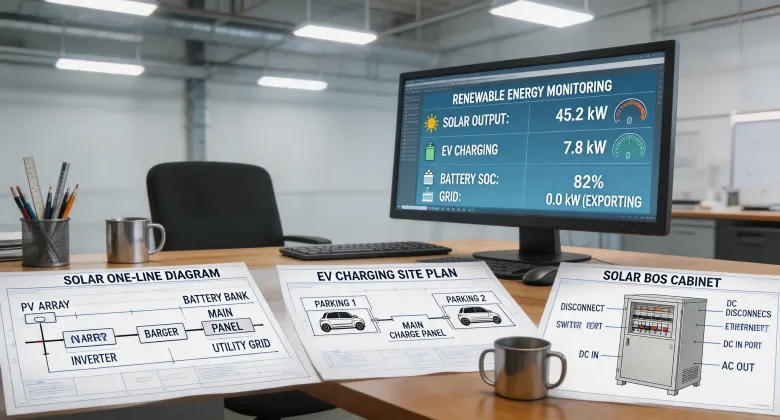
This is the less theatrical scenario, but you can waste more money here than in Scenario A. The request typically includes a solar panel monitoring system and a smart meter, with an EV charger box sometimes added to the same panel. Everyone treats it as one shopping list. In reality, it is at least three separate decisions.
What should your solar panel monitoring system measure?
- If you only want to know whether the inverter is producing, the manufacturer's existing communications may be enough. You might not need additional hardware at all.
- If you need to know how each string or panel is performing, you need string-level or panel-level monitoring, which usually means additional current sensors or optimizer communication.
- If you need to compare solar production with building consumption, you need at least one meter that measures imported and exported energy. A production display alone will not answer that question.
Do not buy hardware before answering the question above. I have seen the same solar panel monitoring system specified for a site where the real issue was utility time-of-use rates. The monitoring system looked great, but it measured the wrong thing, and the customer paid twice.
How to install smart meter: Start with the utility, not the wiring
The phrase smart meter means different things to a consumer, a developer, and a utility. In many territories, the utility owns the meter. You cannot choose an unfamiliar smart meter and ask the utility to install it just because it has a display or a pulse output. You must ask which meters are on their approved list.
I learned this in 2020 when a customer bought a meter with a pulse output and assumed the local utility would accept it for net metering. It didn't. The unit became an expensive display panel, and we had to order a second meter from the utility-approved list. The mistake had nothing to do with the quality of the first device. It was a specification compatibility problem.
For actual installation, remember that service panel work is regulated work. The 2023 National Electrical Code, Article 230, covers service equipment, and Article 690 covers PV systems. Your local authority having jurisdiction can and will apply amendments on top of those. Confirm what they require before ordering hardware.
I am not an electrician, so I won't present a wiring diagram here. What I can tell you from the supply side is that the most common cause of failed smart meter projects is not the wiring. It is the assumption that the utility and the site already agree on the meter specification.
Scenario C: EV charger box is tied to an incentive deadline
This is the situation that feels urgent but is not a true outage. A utility or rebate program gives you until the end of the month. The customer needs an EV charger box installed and inspected by that date. If it doesn't happen, they lose money.
Here is what I see too often: the EV charger box arrives in two days, but the project still misses the deadline because the panel needs a load calculation, the utility needs a meter approval, or the inspector's calendar is full. A faster box does not fix a slower permit system.
In December 2023, three customers asked us to expedite EV charger boxes before an incentive deadline. All three boxes arrived on time. Only one customer received the incentive. The other two had service panels with no spare capacity, which meant upgrades, a second set of permits, and missed inspection windows.
If this matches your situation, the first question is not whether the distributor can ship the EV charger box tomorrow. The first question is: what has to be true for me to pass inspection by the deadline? Utility approval, panel capacity, meter permit, and breaker availability all have their own lead times. Work backwards from the legal deadline, not from the purchase order date.
For the hardware side, ask the same transparency question. An EV charger box quote often excludes the breaker, conduit, wall mounting kit, and the cost of a second trip if the site is missing a neutral. The charger box itself is not the entire job. If your specification says a specific Siemens charger model, do not accept a substitution unless the engineer of record signs off. Inspectors compare the label on the box to the label on the approved plan.
Which scenario are you in?
When I get a call labeled emergency, the first question I ask is: What actually happens if this does not ship today?
- Site is down or losing production now: treat it like Scenario A. Pay for physical inventory verification and exact Siemens disconnect switch specifications. Do not try to minimize the total cost at that moment.
- External deadline exists, but the site is still running: treat it like Scenario C. Map the full approval and inspection timeline, then decide whether the box or the panel is the true constraint.
- No one is losing money today, and the goal is better data, net metering, or future modernization: treat it like Scenario B. Use standard delivery and spend more time on specifications than on freight speed.
When someone asks for same-day delivery on a Siemens disconnect switch, they need support, not a lecture. My job is to find the honest answer: get the exact part, verify it physically, and list every fee before it is charged. The same principle applies to solar monitoring, smart meter work, and EV charger box orders.
Pay for certainty. Do not pay for someone else's vague idea of same day. If a supplier cannot tell you what is not included, the quote is not a quote.
I am not an engineer or an inspector. This guidance is based on my own 214 rush orders and the supply side of those projects. Pricing examples above are from specific quotes in March 2024 and December 2023; current rates will vary. Codes and utility requirements change, so verify with your authority having jurisdiction before ordering.

Renata Silva
Renata Silva is a photovoltaic module analyst covering monocrystalline solar panels, bifacial modules, TOPCon and heterojunction designs, glass-glass construction, junction boxes, and module warranties. She interprets IEC 61215 and IEC 61730 evidence while comparing rated power, conversion efficiency, temperature coefficient, bifaciality, insulation, mechanical-load results, degradation assumptions, and tolerance. Her technical guides help EPC engineers, distributors, and project buyers separate qualification evidence from site-specific energy yield, climate exposure, installation constraints, and long-term performance risk.