Siemens AC Disconnect, Wind Turbines & EV Charging: 8 Questions Power Pros Actually Ask
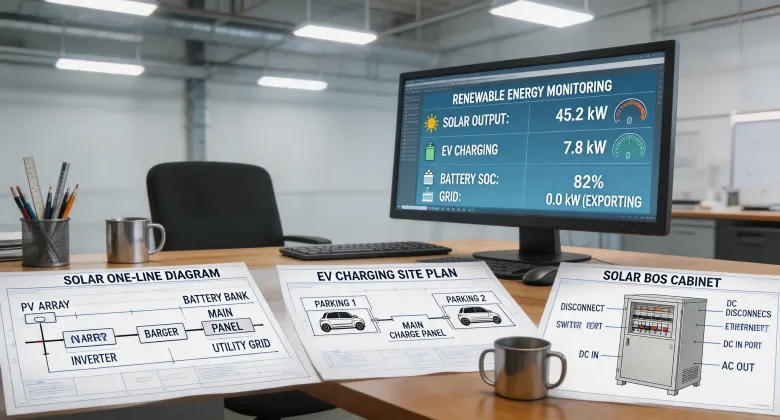
I've been in the energy infrastructure world for over a decade, mostly coordinating emergency replacements and rush installations for utility companies and commercial developers. In my role, if a 100 amp disconnect fails on a Friday afternoon, the project doesn't stop. You figure it out. So, I've seen the good, the bad, and the 'how did that spec sheet get approved' of Siemens hardware and renewable integration.
Below are the questions I get asked most often—from engineers on-site to developers trying to figure out their first EV charging station—and the real answers based on what I've actually dealt with.
1. Is there a standard Siemens AC disconnect switch for solar, or does it depend on the inverter?
It depends on the inverter, but not in the way you might think. The disconnect itself—like a Siemens 100 amp disconnect or a 60 amp—is a relatively standard heavy-duty switch rated for AC. But the application determines the specifics.
For residential solar inverters, you're often looking at a 30A or 60A fused or non-fused disconnect mounted near the inverter or at the service entrance. For commercial setups with multiple inverters, we spec bigger, like a 100A or 200A Safety Switch. I once had a client spec a standard 100A disconnect for a 50kW solar array, but it turned out the inverter's output was 480V three-phase, which required a specific voltage-rated switch. We caught it during the final review, but only because the installer flagged it. Don't assume a disconnect is universal just because the amperage matches; check the voltage rating and type (fused vs. non-fused) against the inverter's requirements. As of my last big order in May 2025, the standard Siemens 100A non-fused disconnect is a workhorse for the 200-300A range, but always cross-reference with the specific inverter's manual.
2. Is the Honeywell Windgate a good turbine for a small commercial project, or should I just spec Siemens Gamesa?
Depends completely on your definition of 'good.'
The Honeywell Windgate is a small-scale wind turbine (around 100kW range, I think). It's a different animal from the utility-scale turbines from Siemens Gamesa (like the SG 2.1-122 or the massive offshore turbines). For a single building or a small farm, the Windgate could be a viable distributed energy resource. For a commercial developer building a wind farm selling power to the grid? You need a Siemens Gamesa turbine.
Where people mess up is trying to use a small turbine like a big one, or vice versa. I had a developer in Q2 2024 who tried to plan a 'micro-grid' around three Honeywell turbines for a warehouse complex. The problem wasn't the turbines; it was the grid interconnection study. The utility assumed they'd need the same infrastructure as a large wind farm, which was overkill and expensive. Take this with a grain of salt, but for a single-site deployment (farm, school, small business), the Honeywell Windgate can work if you manage the permitting. For anything you want to sell back to the grid at scale, Siemens Gamesa is the standard. It's about the project, not just the turbine.
3. What's the real difference between a 'solar generator' and a battery storage system for a commercial site?
The marketing conflates them, but the difference is critical.
A solar generator is usually a portable, all-in-one unit with a battery, inverter, and charge controller. Great for emergency backup or a construction trailer. It's a consumer product.
A battery storage system (like a Siemens or a Tesla Powerpack) is a fixed installation designed for load shifting, peak shaving, and grid services. It integrates with your building management system. This is the industrial solution.
The biggest mistake? Thinking a solar generator can substitute for a proper storage system. I know a project manager who tried to power a cell tower backup with a few 'solar generators.' The runtime was hours, not days, and the charging logic couldn't handle the load profile. He now specifies industrial-grade battery cabinets. The pros of 'generators' are low upfront cost and portability. The cons are limited capacity, lower cycle life, and lack of integration. For a utility company, they're a novelty. For a commercial developer, they're a risk.
4. How do I even find the right Siemens surge protector for a wind turbine or a solar farm?
This is one of those 'paperwork' things that feels annoying until you get it wrong.
You're looking for Type 1 or Type 2 surge protective devices (SPDs) rated for the system voltage. For wind turbines (big ones, like Siemens Gamesa), you need SPDs on the AC side (480V or 690V) and potentially on the DC bus. For solar, you need them on the DC combiner box output and the AC side of the inverter.
The best way to find the exact model is to get the disconnect switch catalog pdf or the SPD catalog from the Siemens website. Look for part numbers starting with 'S' or 'TV.' The tricky part is the 'triggering voltage' and 'surge current rating.' I once saw an engineer spec a 20kA SPD for a substation feed. The utility's requirement was 50kA. The cheaper SPD would have fried on the first big surge. So, check the utility or grid interconnection agreement for the minimum surge rating. As of July 2025, the standard is usually 40kA-100kA for commercial solar, and higher for wind farm substations. The Siemens portfolio is massive, but the Siemens 100 amp disconnect usually comes with a built-in SPD option, which simplifies things for a feeder. Don't skip this step; a bad SPD is a fire risk and a warranty nightmare.
5. Why is 'grid infrastructure' always the bottleneck for my EV charging station project?
Because almost no one budgets enough for the grid connection. The chargers themselves (the Siemens VersiCharge, for example) are the easy part.
The bottleneck is the transformer, the switchgear, the metering, and the utility's interconnection process. If you're putting in 10 fast-chargers (150kW each), you need a massive amount of power (1.5MW+). That means a new transformer, upgraded switchgear, and a lot of digging. The how to open an ev charging station guides often skip this part.
I got involved in a project in Austin, Texas, where the developer had ordered 20 Siemens 100 amp disconnects for the charger stalls and the main switchboard. Great. But they hadn't talked to the utility. The utility needed a 2.5MVA transformer, which had a 12-month lead time. The disconnects sat in a warehouse for a year. The grid infrastructure—the transformer, the busbar, the protective relaying—is the part that takes the most time and money. Budget for the 'iron in the ground' first, then the chargers.
6. Is Siemens AC disconnect 'rated' for outdoor use on a wind turbine? I'm getting conflicting info.
Yes, it is, but 'outdoor' has different levels.
The standard Siemens Heavy Duty Safety Switches (like the SDF series) are often NEMA 3R rated. That's rainproof and sleet-resistant. That's fine for a wall or a pole.
For a wind turbine, you're often in a harsh environment—salt spray if offshore, dust if on a farm, extreme temperature swings. You might need a NEMA 4 (watertight and dust-tight) or NEMA 4X (corrosion-resistant) enclosure. I once had a client order the standard NEMA 3R disconnect for a coastal wind farm. Within six months, the contacts corroded from the salt air, causing a nuisance trip. We swapped it to a NEMA 4X stainless steel version. The cost difference was maybe $200. The downtime cost more than that. Check the location and the enclosure rating. For a wind turbine nacelle, you probably need a more robust enclosure.
7. 'Solar generator pros and cons' for a commercial backup system—is it worth it?
For emergency lights and a coffee maker? Pros: Cheap, silent, no installation. Cons: Limited runtime, can't run HVAC.
For a real business continuity system? Cons: Not scalable, limited power (usually 1-3kW), battery chemistry isn't designed for daily cycling in a commercial setting. Pros: It's better than nothing for a few hours.
I'd argue that for any commercial application, you're better off with a permanent standby generator (diesel or natural gas) or a proper battery system connected to your solar. The solar generator is a consumer device. It's not reliable enough for a server room or a freezer unit. If you're asking this question because you saw a TikTok video, stop. Talk to an electrical engineer. Spend the money on the right infrastructure.
8. What's the number one rookie mistake I see when people are planning a wind + solar + battery + EV charging site?
Under-specifying the electrical infrastructure.
They plan the turbines, the batteries, the chargers, but they treat the main switchboard, the busbar, and the AC disconnects as an afterthought. I've seen a developer plan a 2MW solar farm and a 500kW wind turbine, but then spec a single Siemens 100 amp disconnect for the combined output. That's like planning a highway but buying a driveway gate.
The combiner panel, the main service disconnect, and the transformers need to handle the total cumulative peak current, not just the largest single source. They also need proper protection coordination (the breakers and fuses need to 'talk' to each other). My biggest regret in my early career was not spending enough time on the schematic's one-line diagram. I fixed a lot of those mistakes as rush orders later.

Renata Silva
Renata Silva is a photovoltaic module analyst covering monocrystalline solar panels, bifacial modules, TOPCon and heterojunction designs, glass-glass construction, junction boxes, and module warranties. She interprets IEC 61215 and IEC 61730 evidence while comparing rated power, conversion efficiency, temperature coefficient, bifaciality, insulation, mechanical-load results, degradation assumptions, and tolerance. Her technical guides help EPC engineers, distributors, and project buyers separate qualification evidence from site-specific energy yield, climate exposure, installation constraints, and long-term performance risk.