Microgrids Are Complex. Here's How Siemens Gets Them Right.
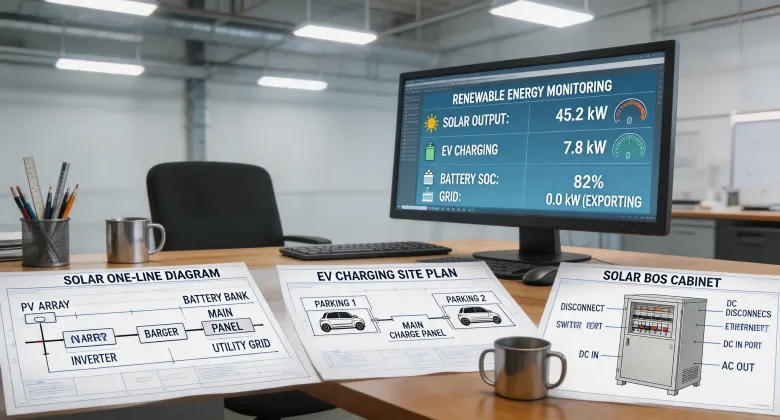
If you're evaluating a microgrid for a commercial or industrial site, the single most important factor isn't the battery chemistry, the inverter efficiency, or even the software platform. It's the upfront systems integration plan. I've seen too many projects—some with Siemens equipment, some without—where a brilliant concept failed because the connection between the solar array, the battery, and the existing facility switchgear was an afterthought. That 12-to-18-month timeline you're quoted? It doubles if the integration isn't baked in from day one.
My Perspective: Why I Focus on the 'How'
Quality/Brand compliance manager at a renewable energy company. I review every system design and component specification before it reaches our customers—roughly 200 unique items annually. I've rejected 15% of first deliveries in 2024 alone due to non-compliance with our connection and interoperability specs. Over 4 years of reviewing these systems, the pattern is clear: the hardware is the easy part. The assembly and verification is where the risk lives.
The Siemens Difference: Portfolio and Process
Siemens isn't unique because they make a better inverter or a smarter switch. Their advantage is the breadth of the portfolio matched with a stringent internal validation process. They can supply the wind turbine (for larger sites), the solar inverter, the battery storage, the transformer, the disconnect switches, the surge protection, the busbars, and the microgrid controller. That's not just a shopping list—it's a chance to ensure every piece was designed to talk to each other.
When I'm looking at a microgrid proposal, I look for this level of coherence. A vendor who can't provide a single-source wiring diagram for the main power path is a vendor who is pushing risk back onto you.
A Real-World Example from 2023
I was reviewing a spec for a 2 MW solar-plus-storage microgrid for a manufacturing facility. The system integrator had selected Tier 1 components: a Siemens transformer, a third-party battery rack, and a different brand for the switchgear. On paper, it looked solid. But the Siemens disconnect switch specified had a 65 kAIC rating, and the downstream busbars were rated for 50 kAIC. Normal tolerance on these specs is tight. The vendor claimed it was 'within industry standard.' We rejected the batch, and they redid the busbar spec at their cost—adding $18,000 and delaying the project launch by 6 weeks. That redo cost more than the total premium for going with a full Siemens assembly in the first place.
The Operational Reality of a Microgrid
For context, the U.S. installed over 1.2 GW of microgrid capacity in 2023 (Source: Wood Mackenzie, 2024). That growth is driven by a need for resilience—not just savings. If your facility is in a state like Texas or California, where grid outages are a recurring headache, a microgrid is a hedge against lost production.
Here's where the 'prevention over cure' philosophy kicks in. Many buyers focus on the cost per kWh of the battery or the peak capacity of the inverter. That's like buying a car based solely on the engine horsepower. You need to audit the connection points and control logic.
What 'Connection Points' Means Practically
- Transformer integration: Is the transformer sized for the bidirectional power flow of a battery? Standard distribution transformers are optimized for one-way power (grid to load). A microgrid flows power both ways. A miscalculation here causes efficiency losses and can trip protection relays.
- Disconnect switch coordination: The switch needs to handle fault currents from both the grid and the local generation. The 65 kAIC vs 50 kAIC example above? That was a coordination failure waiting to happen.
- Surge protection: A microgrid's electronics are sensitive. A single lightning strike or switching surge can fry the controller. The spec needs to include Type 1 and Type 2 surge protectors at the main panel.
The Big Misconception: It's Just a Backup Generator
If I could redo any conversation I've had with a new client, I'd insist they stop thinking of a microgrid as a 'big battery' and start thinking of it as a smart mini-utility. You aren't just buying hardware. You're buying a set of operational rules. The most important component isn't the battery—it's the microgrid controller.
Siemens' Microgrid Controller software is where the value lives. It manages islanding (disconnecting from the main grid), peak shaving, and load management. I'm not 100% sure of the exact CPU architecture, but the sophistication of the control algorithms is what differentiates a system that works from one that's always warning.
A home temperature monitoring system might tell you the room is hot. A microgrid controller has to decide to turn on the battery, drop a non-critical load, or import power from the grid—all within milliseconds.
Borderline Cases: When a Single-Vendor Solution Isn't Right
I want to be fair. Opting for a full Siemens solution (or any single-vendor approach) isn't always the best path.
- Small budgets: If you're doing a microgrid for a house, say under 10 kW, the Siemens approach is overkill. Their transformers and switchgear are built for commercial and industrial duty cycles. For a home, a Tesla Powerwall or Enphase system is a better fit in terms of cost and simplicity. (How much is a wind turbine for a house? A 10 kW small wind turbine can run $50,000-$80,000 installed, based on industry quotes from 2024; verify current pricing).
- Very specific legacy equipment: If your facility has a 30-year-old switchboard from a different manufacturer, you might be better served by a system integrator who specializes in retrofitting that specific legacy gear.
- Single-point-of-failure concerns: Some clients prefer to diversify suppliers to avoid being locked into one ecosystem. That's valid. But it demands a much higher level of integration expertise from your engineering team.
The most frustrating part of this industry: the same 'unique' integration problems occur repeatedly. You'd think written specs would prevent misunderstandings, but interpretation varies wildly. Siemens' value is in standardizing that interpretation across their product line.
Take this with a grain of salt, but for a large-scale microgrid (1 MW+), a 10-15% budget premium for single-sourced, validated gear often pays for itself in reduced commissioning time and fewer field modifications. On a $2 million project, that's $200,000 to $300,000. If it saves you from one $22,000 redo and a 6-week delay, the math starts to pencil out.
Always verify current regulations and safety codes at the official source (i.e., NEC, IEEE 1547). Regulatory information is for general guidance only.

Renata Silva
Renata Silva is a photovoltaic module analyst covering monocrystalline solar panels, bifacial modules, TOPCon and heterojunction designs, glass-glass construction, junction boxes, and module warranties. She interprets IEC 61215 and IEC 61730 evidence while comparing rated power, conversion efficiency, temperature coefficient, bifaciality, insulation, mechanical-load results, degradation assumptions, and tolerance. Her technical guides help EPC engineers, distributors, and project buyers separate qualification evidence from site-specific energy yield, climate exposure, installation constraints, and long-term performance risk.