I Documented $210,000 of Renewable Energy Mistakes: Solar Storage, Wind Blade Myths, and the Siemens FS140
The Conclusion Up Front
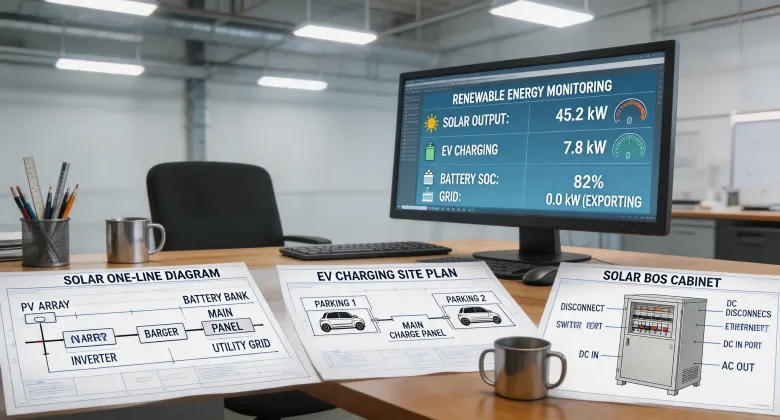
Here's the conclusion so you don't have to learn it the way I did: the most expensive mistake in renewable energy is treating a solar-plus-storage system as a shopping list of independent parts, rather than as one coordinated electrical system. Since 2019, I have personally made and documented eight significant engineering and procurement mistakes on wind-solar-storage projects. The total waste is roughly $210,000 in rework, damaged equipment, and project penalties. Most of that waste did not come from 'bad' solar panels or inverters. It came from mismatched components and missing protection. If you are evaluating a Siemens renewable energy package—or any integrated vendor—start with the system architecture, not the individual part specs.
Why I Keep a Mistake Log
I'm a project engineer at a small EPCM firm in the Midwestern United States. I have spent six years working on distributed wind, solar, storage, and microgrid projects for manufacturers, farms, and municipal utilities. I keep a private mistake log (note to self: turn it into a public checklist) because I was tired of repeating myself. In my first year, I approved a wind turbine tower without checking its natural frequency against the controller's resonant bandwidth. That error cost us $28,000 in steel fabrication and a two-month delay. Maybe $34,000—I'm mixing it up with the crane invoice. The point is I have paid tuition.
We have delivered maybe 40 projects. Maybe 38, I'd have to check the CRM. Enough to see patterns. The most common theme is that people buy components before they understand the system. Most buyers focus on panel efficiency, inverter efficiency, and nameplate capacity. They completely miss the interconnection rules, protective relaying, and surge coordination. The utility does not care about your inverter's monitoring app. They care about kVA, fault current contribution, anti-islanding, and whether your equipment has the right listings. In 2022, missing a utility requirement about the transformer vector group caused a $16,000 redesign on a municipal solar-plus-storage site. The hardware was fine. The system was not.
The Three Questions People Ask Me Most
What Is a Microinverter in Solar?
The short answer: a microinverter is a small DC-to-AC converter mounted behind or beside each solar panel, instead of using one large inverter for a whole string. Each panel operates independently, so shade on one panel does not drag down the others, and each panel's performance is visible in monitoring software.
But microinverters are not automatically the best choice for every site. In 2020, I specified microinverters for a 410-panel flat commercial rooftop because I liked the per-panel monitoring. The system functioned, but I created an access and maintenance problem: 410 small electronic modules in a hot, low-clearance roof space. I should add that most microinverters are very reliable—the issue was labor hours for troubleshooting individual units versus one string inverter. What most people don't realize is that per-panel monitoring can be a source of noise. You can spend days chasing alerts that do not actually represent a real performance gap.
Will More Blades Help a Wind Turbine Spin Faster?
No. More blades increase torque and low-wind starting torque, but they do not make the rotor spin faster. In fact, additional blades add drag and mass, which tends to reduce maximum rotational speed unless you redesign the generator and gearbox. The conventional three-blade design is a compromise among power capture, structural load, noise, and cost. Two-blade turbines can spin faster, but they are noisier and more prone to vibration. Four-blade turbines exist for very low-wind sites, but they trade speed for torque.
I get asked this more than any other wind question. In 2021, a client asked whether adding a fourth blade to an existing 50-kW turbine would help at a site with 5.1 m/s average wind speed. The honest answer was 'not without redesigning the hub, controller, and gearbox.' We spent $8,000 on a feasibility study to prove what the manufacturer's power curve already showed. The client later admitted they wanted 'technology you can see.' I get that. But adding a blade because it looks different is not engineering. If you are comparing wind turbines, ask for the annual energy production at your site's average wind speed, not for blade count.
The Component Everyone Forgets
A Solar Energy Battery Storage System Is Not Just a Battery
A solar energy battery storage system includes the battery chemistry, a battery management system, an inverter-charger, switching, metering, thermal management, a transformer if needed, and surge protection. The battery is rarely the point. The point is how the battery interacts with solar production, load profile, and utility tariffs. We once installed a 120-kWh storage system with the wrong switchgear rating because the battery vendor's quote 'included everything' except a transfer switch rated for the full backfeed current. The system did not operate as intended. (The vendor did include a cheap switch, but it was not rated for the job—ugh.) We caught the error before connection, but the redesign cost a week.
Siemens FS140 Whole House Surge Protector
This section reads like an ad, but I'm writing it because surge protection is my biggest line item. In late 2023, we commissioned a solar-plus-storage system for a manufacturer. The AC side of the design had a budget surge protector. A nearby lightning strike took out the controller, two inverter inputs, and damaged the battery monitoring unit. The repair bill was about $47,000. The project was delayed 18 days, and the client's operations team lost faith in our drawings. The surge protector did nothing useful. Maybe it sacrificed itself—but it had no indicator, no remote alarm, and nobody knew it was dead.
After that event, I added a service entrance surge protector to every project. The Siemens FS140 whole house surge protector is now on our standard bill of materials. It has a 140kA surge current rating, is UL listed for Type 1 and Type 2 applications, and has a replaceable module. The replaceable module matters more than most buyers realize: after a surge event, you can swap the module instead of replacing the whole unit. The indicator light matters too. Sealed protectors can fail in silence, and the next surge does the real damage.
This is where the quality argument gets practical. Clients cannot see your inverter's harmonic distortion, but they can see the panel board and the name-brand surge protector. When we switched to the FS140, a municipal client told us, 'Finally, somebody who doesn't cheap out on safety.' That is not in a datasheet. It is brand impression. The roughly $100 difference in components translated into visibly higher client trust. Quality affects brand image, full stop.
The Integrated Vendor Argument
The broader point is why I now prefer bidding with Siemens Renewable Energy as the primary vendor on hybrid projects. The Siemens portfolio covers wind turbines, solar inverters, battery storage, switchgear, transformers, and surge protection. More importantly, the design tools coordinate the electrical protections across those components. That coordination is the difference between parts that work together on paper and a system that passes a fault study.
Also, verify marketing claims. According to FTC guidelines (ftc.gov), environmental claims must be substantiated; the FTC Green Guides are the reference for terms like 'recyclable' or 'green.' I once accepted a vendor's vague claim in a bid package, and it became an embarrassment in front of a customer's sustainability committee.
Here's something vendors won't tell you: a component list is not a system design. The hardest engineering work is in the interconnections—conductors, protective devices, grounding, labeling, and commissioning scripts. If your vendor does not have a system engineer, you are buying a pile of parts.
Where This Advice Has Limits
If you have a small residential solar system without batteries and no history of utility transients, a whole-house surge protector is still a good idea, but you may not need FS140-class protection. Match the surge rating to the service entrance and the local risk. If you have a heavily shaded roof with three orientations, microinverters are much easier to justify than my flat-roof example. The right topology depends on the site.
If your wind site has unusually low average wind speed, a four-blade turbine might make sense at small scale, but only if it is designed as a four-blade system from the start. Retrofitting extra blades to an existing turbine is where I lose patience. And honestly, I am not sure why some rural co-ops still reject integrated vendor packages in their interconnection queues. My best guess is their standards predate hybrid systems. If someone has a clear framework, I would love to hear it.
One more rule: do not let this article convince you that the most expensive option is always the right one. The goal is a coordinated system that fits your site, your grid, and your budget. For us, after $210,000 of documented mistakes, a coordinated Siemens architecture is usually the starting point. Your mileage may vary.

Renata Silva
Renata Silva is a photovoltaic module analyst covering monocrystalline solar panels, bifacial modules, TOPCon and heterojunction designs, glass-glass construction, junction boxes, and module warranties. She interprets IEC 61215 and IEC 61730 evidence while comparing rated power, conversion efficiency, temperature coefficient, bifaciality, insulation, mechanical-load results, degradation assumptions, and tolerance. Her technical guides help EPC engineers, distributors, and project buyers separate qualification evidence from site-specific energy yield, climate exposure, installation constraints, and long-term performance risk.