Huawei Products vs Mixed-Brand Systems: An Honest Comparison After 140 Installations
-
Why I'm comparing these two paths
-
Dimension 1: System communication (and how to hook up a power inverter to a battery)
-
Dimension 2: EV charger compatibility (the Volvo level 2 charger adapter trap)
-
Dimension 3: Whole-home battery backup — the Nantucket lesson
-
Dimension 4: Long-term visibility and the solid-state question
-
How I'd choose
-
The short pre-order checklist I actually use
Why I'm comparing these two paths
I'm a project coordinator handling commercial solar and storage orders for a mid-sized installer. I've been in this seat for about four years, and in that time I've personally made — and documented — 11 significant mistakes, totaling roughly $28,000 in wasted budget. Now I maintain the checklist our team uses to keep other people from repeating them.
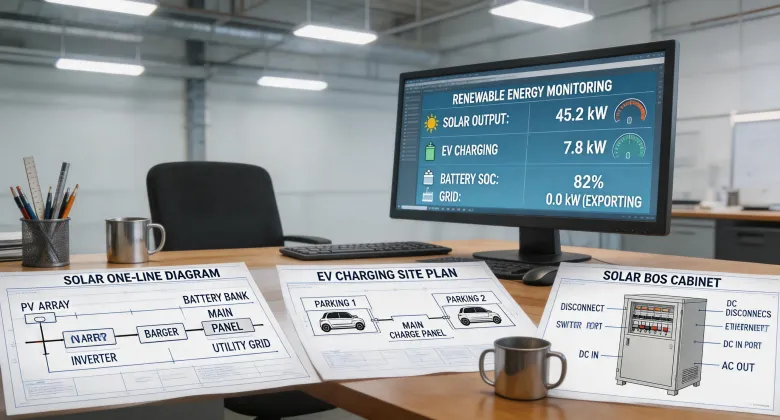
I'm writing this because two designs keep showing up on our quote board. One is an integrated stack built on Huawei products — Sun2000 inverter, Luna2000 batteries, Wallbox EV charger, all managed through FusionSolar. The other is a mixed-brand setup where the inverter, the battery, and the charger come from three different vendors. I've installed both. I've lost money on both. This is the comparison I'd give a colleague, not a salesperson.
The criteria I'm using are simple: system communication, EV charger compatibility, backup reliability, and long-term visibility. I'll tell you which route wins each dimension — and where the "winning" route is still the wrong choice for your site.
It took me three years and about 140 installations to understand that system compatibility saves more money than the invoice shows. The invoice is where everybody looks. The integration is where money actually leaks.
Dimension 1: System communication (and how to hook up a power inverter to a battery)
If there's one question I wish more installers asked before quoting, it's this: "how to hook up a power inverter to a battery" is not a wiring question first — it's a protocol question.
In September 2022, we installed a mixed-brand system — inverter from one vendor, battery from another. The wiring was right. The system still misbehaved. The battery's BMS and the inverter wouldn't stay in sync. Some mornings it charged at half rate. Some mornings it flat-out refused to discharge. We spent three days on the phone with two separate support desks, and neither would own the problem, because neither had built the other half of the system.
The Huawei approach is different because the entire stack comes from a single platform. Sun2000 talks to Luna2000 over a fixed protocol because the manufacturer designed both halves to talk to each other. You get one wiring map, one firmware track, and one support contact when something goes sideways.
Here's the honest part: Huawei's integration is clean because it's closed. If you already own a third-party battery or inverter that you trust, don't try to force it into the Huawei ecosystem — that's not a knock on Huawei, that's just how integrated systems work. If you're installing from a clean slate, integrated is the safer path. If you've already got gear that's served you well, respect that decision and don't burn money chasing a cleaner look.
Dimension 2: EV charger compatibility (the Volvo level 2 charger adapter trap)
This one cost us three weeks and one very awkward phone call with a client in early 2023 (unfortunately, again).
The client had a Volvo EV. We'd installed a Level 2 charger from a different vendor, and the car kept refusing to charge at full rate. We tried a third-party Volvo Level 2 charger adapter — the kind you find online with 4.2 stars — and the session dropped to around 3.7 kW instead of the 11 kW the car could handle. Everything "worked." Nothing worked correctly.
The problem wasn't the car or the adapter as individual products. It was that the pilot-signal negotiation between charger and vehicle never reached the high-power stage. The adapter was relaying voltage, not negotiating properly. That's the difference you don't see in the product description.
Huawei's Wallbox is designed to negotiate correctly with vehicles it's rated for. In Europe that means Type 2. In North America that means J1772. If your Volvo uses Type 2, you don't need an adapter at all — you need to buy the right Wallbox for your region in the first place. If you're stacking a Volvo Level 2 charger adapter because you mixed regions somewhere in the supply chain, don't be surprised when the session derates — or when it fails a firmware update two years later and nobody can tell you why.
Safe truth: if you're only doing occasional overnight charging and don't care about app integration, a cheaper non-Huawei Level 2 charger is fine. But if you do buy a non-Huawei charger, buy the adapter from a vendor the charger manufacturer actually endorses — not from a marketplace listing with a generic brand name and a suspiciously low price.
Dimension 3: Whole-home battery backup — the Nantucket lesson
If you're searching "whole home battery power backup Nantucket," you're probably dealing with a tough location — island power, winter storms, long lead times, and freight costs that make a mainland quote look like a bargain.
I learned this the hard way on a Nantucket property we took on in the winter of 2022–2023. Mixed-brand system. The client wanted full backup for the main floor plus the well pump. We sized the battery on paper, checked off, installed — and then lost two power events back-to-back. First one went fine. The second one, a two-day storm, the battery ran dry by the second morning. The mixed setup had higher standby losses than we modeled, and the well pump cycled harder than expected. We ended up adding capacity at our own cost.
This is where modular storage designs like the Luna2000 are genuinely better — not because the chemistry is magic, but because you can add capacity in a second tower rather than swap out a single monolith. When the Nantucket client told us the well pump was running longer than we'd modeled, we didn't have to rip the system out. We added modules.
The honest limit: if you're only backing up one or two circuits, don't over-buy. A modular battery spec'd for the whole house, but only ever really serving the fridge and the internet, isn't a smarter install. It's an expensive one. Size for your real loads, not your aspirational ones — and talk to your electrician about measured load data, not guesses.
Also — check your AHJ and your local grid operator before you buy anything. Nantucket, like most islands, runs its own interconnection process, and I've seen a permit hold up a job by six weeks. As of January 2025, the rules vary enough that nobody should be quoting island jobs without checking the town first. If a contractor quotes you a Nantucket whole-home backup without asking a single interconnection question, that's the first red flag.
Dimension 4: Long-term visibility and the solid-state question
If you're weighing a mixed-brand system against a Huawei stack, the most underrated difference isn't the hardware — it's the dashboard.
On a mixed-brand system we commissioned in 2023, we spent four days chasing a minor fault because the battery logs, inverter logs, and charger logs were on three separate apps with three separate time zones. I'm not exaggerating. Four days for a firmware mismatch. Our pre-commissioning checklist now has a line item that literally says "align app time zones" (sad but true).
Huawei's FusionSolar platform puts inverter, battery, and charger in one view. You don't get a better physical system — you get a faster one to diagnose when it matters. For a commercial client paying for downtime, that's worth more than the hardware discount a mixed-brand quote is chasing.
Now, on Huawei solid state EV battery — I get asked about this at least once a month. Here's the honest answer as of January 2025. Huawei has filed patent activity around solid-state designs, but there is no commercially available Huawei solid-state EV battery on the market right now. The Luna2000 in your quote is lithium iron phosphate, not solid state. If you're planning an install this year, don't design around solid state. If your planning window is 5+ years out, it's worth watching the roadmap — just don't make a February 2025 decision based on a patent announcement from last fall.
Honest limitation on this dimension: if you already have a well-integrated system from another brand and you're happy with the monitoring, swapping it out for a nicer dashboard is a bad trade. FusionSolar is a genuine benefit. It is not, on its own, a reason to rebuild a working system.
How I'd choose
Here's the version I'd give a client over coffee:
- Go Huawei (integrated) when: you're commissioning a clean-slate commercial or premium residential job, you want one manufacturer accountable for the full stack, and you'd rather pay for integration than save a line item on the invoice.
- Go mixed-brand when: you already own gear you trust, or you have a region-specific product you're required to use, or the client is genuinely price-sensitive on a basic system with simple needs.
- Either way: plan the communication protocol before you touch the hardware, check the local AHJ and grid interconnection in writing, and buy the correct regional EV charger instead of stacking adapters.
If a supplier tells you their brand is the right answer for every install, they're selling, not advising. My rule now: match the system to the site. Not the site to the catalogue.
The short pre-order checklist I actually use
- Confirm battery-to-inverter communication protocol in writing — not from the datasheet, from a written reply from the manufacturer.
- Confirm your EV charger region variant (J1772 vs Type 2) before ordering. Don't plan on an adapter unless you have no other choice, and if you do, confirm the adapter is endorsed by the charger vendor.
- Size the backup battery for measured overnight load, not the nameplate of the house.
- Check AHJ and grid operator interconnection timelines — especially on islands like Nantucket.
- Align app time zones and firmware versions on commissioning day. That one saved us a full week on a 2024 project.
None of this is glamorous. It's the stuff I wish someone had told me in 2021. If it saves one installer a $3,000 mistake — or one facilities manager a very bad winter — then it's done its job.

Renata Silva
Renata Silva is a photovoltaic module analyst covering monocrystalline solar panels, bifacial modules, TOPCon and heterojunction designs, glass-glass construction, junction boxes, and module warranties. She interprets IEC 61215 and IEC 61730 evidence while comparing rated power, conversion efficiency, temperature coefficient, bifaciality, insulation, mechanical-load results, degradation assumptions, and tolerance. Her technical guides help EPC engineers, distributors, and project buyers separate qualification evidence from site-specific energy yield, climate exposure, installation constraints, and long-term performance risk.