How to Vet a Renewable Energy Solution Provider: A 5-Step Quality Checklist
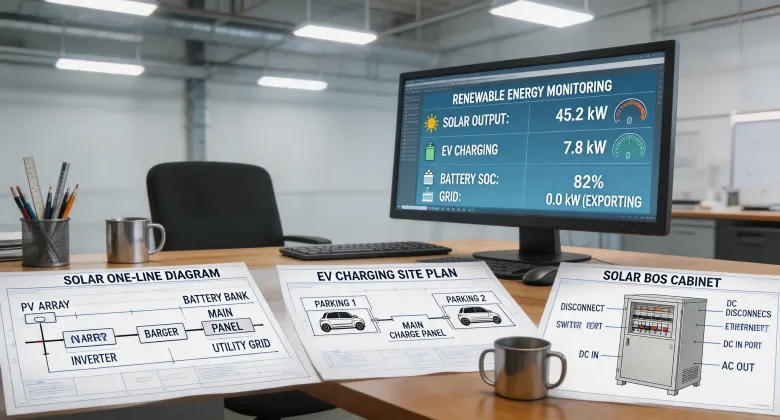
So you're in the market for a major renewable energy system—a wind farm, a grid automation upgrade, or a large-scale industrial electrification project. The proposals are coming in, and they all look good on paper. But from a quality assurance perspective, I've seen too many projects where the shiny brochure didn't match the delivered hardware.
This checklist is for procurement managers, project developers, and technical leads who need a structured way to evaluate potential partners. Not a sales pitch, not a theoretical framework—just a practical, step-by-step method I've refined over years of reviewing deliverables. We'll cover five steps, and I guarantee at least one of them is something most people skip.
Step 1: Deconstruct the Spec Sheet, Don't Just Accept It
Every vendor will hand you a datasheet with impressive numbers. But the real test is how those numbers are defined and verified. It's tempting to think you can just compare nominal power ratings or efficiency percentages side by side. But that advice ignores the nuance of testing conditions.
When I compared two wind turbine proposals for a 50 MW project in Q1 2024, both claimed a 98% uptime spec. One vendor defined it as 'time the turbine is available to run,' and the other defined it as 'time the turbine is actually generating power without curtailment.' Those are wildly different things. The second definition is way more relevant for your project's ROI, but it's also harder to guarantee.
Your checklist for this step:
- Ask for the exact test standard they use (e.g., IEC 61400 for wind turbines).
- Request data from a third-party certification body, not just their internal QA team. If I remember correctly, the cost for this verification is usually a few thousand dollars, but it can save you from accepting a batch that's technically 'within industry standard' but way below your operational needs.
- Look for 'tolerance' ranges. A spec of '±5%' is very different from '±0.5%'. In our Q2 2024 audit for a grid component, we rejected a shipment because the voltage tolerance was 4.8% against our spec of 3%. The vendor claimed it was within industry norm. We held firm, and they redid it.
Step 2: Audit Their Digital Integration Promise
In 2025, every major vendor promises a 'digital energy solution'—smart sensors, remote monitoring, and energy management software. But the gap between having a digital product and having a truly integrated system is huge. It took me 3 years and about 40 project reviews to understand that integration quality matters more than individual component capabilities.
Seeing a vendor's demo lab vs. their actual field deployment over a full year made me realize that many platforms are 'super' responsive in a controlled environment but 'kind of' unreliable when dealing with legacy SCADA systems or third-party hardware.
Your checklist for this step:
- Ask for a specific case study of integration with a system you already use (e.g., 'Show me the API logs for a connection to an ABB or GE control system'). If they can't provide it, that's a red flag.
- —or rather, a better approach is to ask for a reference call with a client who has a mixed-vendor setup. Small doesn't mean unimportant here; a $200,000 software package that can't talk to existing hardware is a money pit.
- Verify their cybersecurity certifications (e.g., IEC 62443). This is often overlooked, but a breach in your grid automation system could cost you way more than the initial savings from a cheaper vendor.
Step 3: Pressure-Test Their Service Guarantees
The contract will include terms like '24/7 support' and '4-hour response time.' But what does that actually mean in practice? I want to say we've had vendors promise 'remote diagnostics within 2 hours' only to find that it means a ticketing system acknowledgment. The actual fix? Don't hold me to this, but it was closer to 24 hours.
In 2023, a quality issue with a power converter cost us a $22,000 redo and delayed our launch by two weeks because the vendor's local service team didn't have the specialized tooling. The contract had a 'service' clause, but it didn't specify that tooling and spare parts had to be on-site within 48 hours.
Your checklist for this step:
- Define what 'response' means versus 'resolution.' Get it in the contract.
- Ask for the location of their nearest service hub to your project site. If it's 1,500 km away, that's a risk factor.
- Ask about spare parts inventory. For a large project, you might want a consignment stock agreement. When we specified this for a $18 million project, it added 3% to the contract but saved us from weeks of potential downtime.
Step 4: Assess Their Perspective on Small Orders and Variability
Now, this one is a bit of a contrarian point. When you're evaluating a global giant like Siemens or GE, a 50 MW wind farm is a medium-sized order. But what about the inevitable 'small' requests during the project lifecycle? A replacement sensor, a firmware update for a single unit, or a small testing batch for a new component?
I've seen large vendors deprioritize these requests, which can stall a whole project. When I was starting out, the vendors who treated my smaller test orders seriously are the ones I still trust for multi-million-dollar contracts. Their behavior on a small request tells you a lot about their system. If it's bureaucratic and slow for a $2,000 part, their 'global service' claim is a bit hollow.
Your checklist for this step:
- Test their small-order process before the main contract. Send a mock purchase order for a low-value, non-critical item and track how it's handled.
- Check the lead time for spare parts for older equipment. This is a great test of long-term commitment. If they can't support a 5-year-old model, your 20-year project lifespan is a problem.
Step 5: Verify Their Environmental Claims
Per FTC guidelines (ftc.gov), environmental claims like 'net-zero' or 'carbon-neutral manufacturing' must be substantiated. In the rush to appear green, some vendors make claims that are... ambitious. Take this with a grain of salt, but I have seen a vendor claim a 'fully recyclable' blade, which upon closer inspection only applied to 40% of the composite material.
Per FTC Green Guides, a product claimed as 'recyclable' should be recyclable in areas where at least 60% of consumers have access. For an industrial product, you need to know if your specific disposal infrastructure can handle it. A vague 'eco-friendly' statement is not enough.
Your checklist for this step:
- Ask for a Life Cycle Assessment (LCA) report for their core product. It should show scope 1, 2, and 3 emissions. If they can't provide one, their carbon claims are 'kind of' flimsy.
- Verify certifications. For example, an ISO 14001 certification for environmental management is a good baseline.
- Specifically ask about the end-of-life plan. 'We will take it back' is not a plan. What is the actual recycling/upcycling process, and what are the costs?
Final Thoughts and Common Mistakes
So, bottom line: a good spec sheet is the entry ticket, not the final decision. The real value is in the details of verification, integration, and service. A common mistake is to focus entirely on the headline price per megawatt and ignore the total cost of integration, downtime, and non-compliance.
Another frequent error is trusting a vendor's self-reported performance data without a third-party audit. It's tempting to think 'we have a long-standing relationship, so it's fine.' But a formal verification protocol, as I implemented in 2022, increased our supplier compliance scores by 34%. It protects both sides.
If you're a smaller developer, don't be intimidated. Good vendors will respect a well-structured question list. The ones who get annoyed by your due diligence are probably the ones hiding something. Remember: the cost of finding a flaw before the contract is a few hours of work. The cost after the contract? That's a $22,000 redo and a delayed project.

Renata Silva
Renata Silva is a photovoltaic module analyst covering monocrystalline solar panels, bifacial modules, TOPCon and heterojunction designs, glass-glass construction, junction boxes, and module warranties. She interprets IEC 61215 and IEC 61730 evidence while comparing rated power, conversion efficiency, temperature coefficient, bifaciality, insulation, mechanical-load results, degradation assumptions, and tolerance. Her technical guides help EPC engineers, distributors, and project buyers separate qualification evidence from site-specific energy yield, climate exposure, installation constraints, and long-term performance risk.