Choosing Siemens Gear for Your Renewable Energy Project: The 6-Step Checklist I Wish I Had in 2022
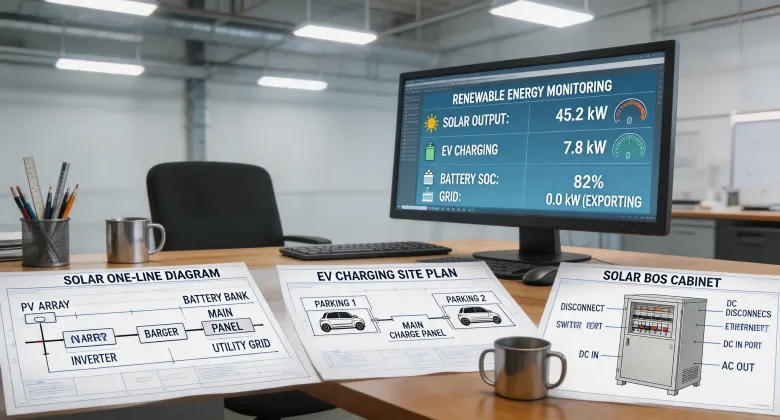
If you're staring down a spec sheet for a new solar farm or a microgrid retrofit and wondering which Siemens components to lock in, this checklist is for you. I'm the guy who documents his own screw-ups so the team doesn't repeat them. In my first year handling renewable energy orders (that was 2021), I made a classic error: I bought the cheapest transformer busbar junction and skipped the inrush current check.
That mistake triggered a cascade failure on a 600A busbar system. We had to reorder a Siemens 600A busbar assembly plus two replacement surge protectors—$9,000 in total, not counting the 3-week project delay.
Since then, I've built a checklist. It has six steps. Here they are.
Step 1: Verify Load Compatibility Before Specifying Any Siemens Surge Protector Breaker
Most people start with voltage. That's fine, but the real trap is the surge protector breaker coordination. You need a Type 1 or Type 2 SPD? For a commercial solar installation with a 600A busbar, you almost certainly need a Type 2 Siemens surge protector breaker rated for at least 20kA per mode.
Here's what vendors won't tell you: the nominal discharge current (In) on the spec sheet is not the same as the maximum surge current (Imax). If you spec a breaker based on Imax alone, you'll undersize the protection for repeated transients. Check the Siemens FS140 series documentation—it clearly distinguishes these. I learned this the hard way after a lightning-adjacent event in August 2023 fried a lower-rated SPD. Cost: $2,800 for replacement hardware and a rushed shipping fee.
Step 2: Confirm the UPS Topology—Don't Assume Online Double-Conversion
If your project involves a Siemens UPS for critical control systems, you need to confirm the topology. There three flavours: standby, line-interactive, and online double-conversion. For any grid-tied renewable project where voltage fluctuations are common, you want online double-conversion. Period.
The mistake I made in September 2022: I specified a line-interactive Siemens UPS for a battery storage control room because it was $400 cheaper. The UPS couldn't handle the sag during a transformer tap change. The controller rebooted mid-cycle. That cost us a 2-day recalibration and a lot of explaining to the client.
Check the Siemens SITOP UPS series for industrial-grade double-conversion units. The price difference is usually about 15-20%. Worth it.
(Honestly, the line-interactive units are fine for office equipment. Not for your grid controls.)
Step 3: Size the 600A Busbar for Future Expansion (and Measure the Actual Lug Spacing)
A 600A busbar sounds straightforward: 600 amps, done. But busbars have a continuous current rating and a short-circuit current rating. Most spec sheets list both. The one that gets overlooked is the short-circuit rating. In a solar-plus-storage scenario where inverters can backfeed, a fault condition can dump massive current into the bus. If your busbar's short-circuit rating is below the available fault current, you'll get arc flash.
And here's a practical tip that came from a $3,200 reorder in Q1 2024: measure the lug spacing on your termination points. I once ordered a Siemens 600A busbar assembly with fixed lug spacing that didn't match the existing transformer studs. We had to order a custom adapter plate ($890 plus 1-week delay).
By the way, Siemens publishes detailed dimensional drawings for their 600A busbar systems online. Print them. Use them.
Step 4: Don't Overlook the Phase Shifting on a Single Phase Hybrid Inverter
A single phase hybrid inverter seems simple—connect solar, battery, and grid. But if your site has three-phase incoming supply and you're using a single phase inverter for a dedicated load (like a critical pump), you need to check the inter-phase voltage.
Here's something surprising: on a single phase inverter, the output is line-to-neutral. If you connect it line-to-line, you'll damage the inverter. I've seen two projects where the contractor tied the single phase hybrid inverter output across two legs of a 208V wye system. Poof. Inverter replaced under warranty? Nope—voided by incorrect installation.
Specific example: For a water treatment plant retrofit, we used a Siemens single phase hybrid inverter with the Sunny Boy Storage integration. The spec clearly said 120/240V split phase. The site had 120/208V wye. We installed a step-down transformer. Cost a bit extra, avoided a failure.
Step 5: Address the 'How Effective Are Wind Turbines' Question Before It Becomes an Objection
Clients will ask this. Especially if they're utility managers used to baseload coal or gas. They've heard the 'intermittent' argument a hundred times. The real answer, based on Siemens Gamesa data, is that site-specific capacity factors now range from 35-55% for modern onshore turbines, offshore is higher. That's not theoretical—that's operational data from projects installed after 2020.
I keep a slide deck with specific projects: a 50 MW onshore farm in the Midwest with a 42% capacity factor over 2023, powered by Siemens Gamesa turbines. When I get the 'how effective are wind turbines' question, I show that number. The average engineer doesn't have it at their fingertips. Be the one who does.
(The old answer—'wind turbines average 30-35% capacity'—was true about 10 years ago. Today's reality is better. Don't cite outdated data.)
Step 6: Set Up the QA Check for Siemens Documentation and Part Numbers
This is the boring step that saves your budget. Before you hit 'order', run this three-item check:
- Part number matches the catalog. Siemens has a habit of updating part numbers quietly. The PDF you downloaded six months ago might be obsolete. I check the disconnect switch catalog pdf or Siemens breaker model ls list pdf on their official site each time before ordering.
- Certification status. Is the component UL 1741 certified for grid-tied solar? Or UL 489 for breakers? If your project requires compliance, the wrong certification means rework.
- Lead time. Call the distributor. Don't trust the website. In early 2023, a popular 600A busbar had a 14-week lead because of component shortages. We swapped to a different Siemens busbar variant with 4-week lead. Same specs. Different warehouse.
I missed that lead time check once. On a project with a fixed completion date. Cost: $1,500 in liquidated damages for the delay. Not fun.
Common Mistakes to Avoid
- Mixing surge protector types on the same load center. If you use a Type 1 SPD at the service entrance, don't put a Type 3 downstream without proper coordination. You'll create a voltage mismatch.
- Ignoring the neutral-ground bond requirement on a single phase hybrid inverter. Some inverters require an external N-G bond. Some have it internal. Check the manual (I know, boring—but cheaper than a redo).
- Using a residential-style busbar for a commercial combiner box. The 600A busbar needs proper bracing for high fault currents. Residential busbars aren't built for it.
This checklist isn't perfect. I'm sure I'll add to it after my next mistake (probably next month). But if you run through these six steps before finalizing your Siemens equipment order, you'll avoid the most expensive surprises. The ones that hit your budget and your timeline.
If you have a checklist item I missed—especially one learned the hard way—I'd genuinely like to hear it. I keep a running document for the team. Every good lesson is worth adding.

Renata Silva
Renata Silva is a photovoltaic module analyst covering monocrystalline solar panels, bifacial modules, TOPCon and heterojunction designs, glass-glass construction, junction boxes, and module warranties. She interprets IEC 61215 and IEC 61730 evidence while comparing rated power, conversion efficiency, temperature coefficient, bifaciality, insulation, mechanical-load results, degradation assumptions, and tolerance. Her technical guides help EPC engineers, distributors, and project buyers separate qualification evidence from site-specific energy yield, climate exposure, installation constraints, and long-term performance risk.