A Solar System in Order from Sun to Service Panel: Siemens Specs Worth Checking
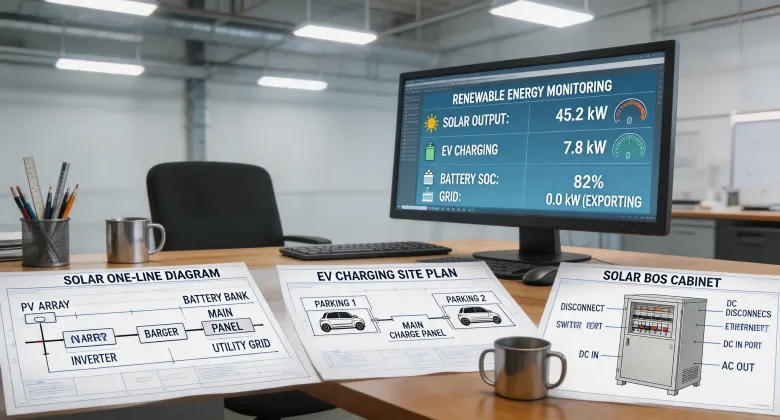
I review electrical equipment submittals for a living. I am not the person who designs the solar array or installs it; I am the person who compares every listed model against the actual system before the order goes out. Over the past four years, that has meant reviewing a few hundred solar, battery, and EV-charging packages. The most consistent mistake is not one bad product. It is the order.
When people search 'solar system in order from sun', the search engine mostly shows planets. In a renewable-energy project, that same phrase should describe the power path. A grid-tied solar system, in order from sun to socket, looks like this:
- PV modules capture sunlight and produce DC electricity.
- DC combiners, rapid shutdown and disconnects safely route that power.
- An inverter converts DC to AC and connects to the grid.
- A visible AC disconnect gives maintenance workers and utilities a positive opening point.
- The main service panel distributes power to the building loads.
- Batteries and EV chargers connect on the correct side of that chain.
Stage 4 is where a surprising number of projects stumble.
The Siemens 200 Amp Disconnect Question
A Siemens 200 amp disconnect can be the right product and the wrong part number, because the enclosure is not the spec. Is it a general-duty safety switch or a service-rated disconnect? What is its short-circuit current rating? Does the application need a fusible switch? Is it the first disconnecting means after the meter? Those questions need answers before installation, not during approval.
What I often find in a re-review is that someone ordered a 200 A disconnect because the main breaker is 200 A. That logic is incomplete. The disconnect must be rated for the fault current available at its location and for the load it will interrupt. The label tells you, and the inspector will read it. I read it too.
If you do not know whether the switch is service-rated, you have not finished specifying it.
I do not say that to be difficult. Saying it on the front end is much cheaper than saying it after inspection.
A Siemens Whole House Surge Protector Is Not a Decoration
Another common search phrase is 'Siemens whole house surge protector'. I like that people are specifying one; it means the conversation has moved beyond power strips. But the installation position is part of the specification.
A Type 1 or Type 2 surge protective device works by shunting a transient to ground before it travels through the building. That requires the shortest practical connection between the protector, the ground bus, and the equipment it protects. In practice, a whole house surge protector belongs at or close to the service entrance. Putting it on a subpanel is not the same.
I rejected a submittal in Q1 2024 for exactly that reason. The bill of materials included a Siemens whole house surge protector, but it was mounted in a 60 A subpanel at the far end of the building. The main panel, which fed almost every sensitive electronic load in the property, had no protector at all. On paper, surge protection existed. In real current paths, it was doing much less than the name implied.
Level 2 Charger Locations Change the Load Calculation
EV charging is the part that sneaks into projects late. The phrase Level 2 charger locations sounds like a mapping question, but to me it is an electrical planning question. The charger is a continuous load, and a 40 A charger normally needs a 50 A branch circuit under NEC rules. That is not hard to add when the panel is empty. It hurts when the main panel is already full after a solar installation.
If you are adding solar plus a charger, map the charger location to a specific panel and study the busbar rating before placing an order. A designer can often interconnect solar with a back-fed breaker under the 120 percent rule. Adding EV charging on the same bus can push that calculation past the limit. The result is a supply-side connection, a service upgrade, or a smaller charger. Those are not terrible options, but they are easier to choose early than to discover at permit stage.
This is where transparent project planning beats a low initial quote. A quote that does not name the charger location, the disconnect type, and the surge protector rating is not necessarily hiding something. It is simply incomplete. I have learned to ask what is not included before asking the price.
How To Actually Check a Solar System After Commissioning
One other search phrase that shows up is 'how to check solar system on snap'. I will give Snapchat its due: that is the app's friend solar system, under the Friend Badges option. It has very little to do with kilowatt-hours.
The more useful question is how to check an actual solar system. On every handover, I ask the installer to walk the owner through the monitoring portal. You want to see today's production, the monthly graph, and any active alarms. Confirm the inverter is communicating before the installer leaves. A production drop is normal on a cloudy day; a permanent flat line is not.
That monitoring login is as important as the label on the Siemens 200 amp disconnect. It is the only way to verify the whole chain, from the first diode in the module to the last circuit in the panel, is doing what the design said it would do.

Renata Silva
Renata Silva is a photovoltaic module analyst covering monocrystalline solar panels, bifacial modules, TOPCon and heterojunction designs, glass-glass construction, junction boxes, and module warranties. She interprets IEC 61215 and IEC 61730 evidence while comparing rated power, conversion efficiency, temperature coefficient, bifaciality, insulation, mechanical-load results, degradation assumptions, and tolerance. Her technical guides help EPC engineers, distributors, and project buyers separate qualification evidence from site-specific energy yield, climate exposure, installation constraints, and long-term performance risk.