6 Questions About EV Charger Installation in Bradenton I Wish I'd Asked
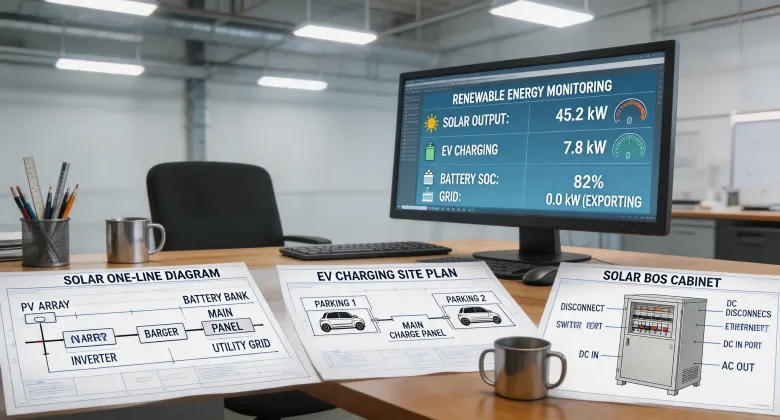
If you're planning EV charger installation in Bradenton for a commercial property, fleet depot, or even a high-end residential community, you are likely looking at Siemens VersiCharge units or similar industrial-grade hardware. I've handled orders for about 250 charger installations over the last four years—and I personally made the mistakes that led to about twelve thousand dollars of rework across three projects in 2023 alone.
Here are the questions I didn't ask, but should have. Learn from my errors.
1. What Permitting and Inspections Are Required in Bradenton?
Most buyers focus on the charger cost and completely miss the inspection hurdles. In Bradenton, an EV charger installation for a commercial location (anything above a simple Level 1 home unit) generally requires an electrical permit from Manatee County. As of January 2025, this is a separate line item from the installation labor.
I once approved a project where we assumed 'standard work permits.' The result was a three-week delay because the county had specific requirements for load calculations on the existing panel. If I remember correctly, the permit cost was around $180, but the delay cost us about $1,200 in lost equipment rental fees. Verify current requirements at Manatee County Building Services.
2. Is My Electrical Panel Ready for the Load?
The question everyone asks is about the charger station. The question they should ask is about the breaker panel and busbar capacity. A single Siemens VersiCharge unit at 48 amps will pull a serious amount of power. If your building already has an HVAC system, commercial kitchen, or elevators, the existing Siemens transformer feeding your building might not have the headroom.
In Q2 2024, we had to install an additional 30 kVA transformer for a small commercial lot because the existing 75 kVA unit was already at 85% load. That transformer cost $3,400 plus a week of electrical subcontractor time. Savings: a quick load calculation up front would have cost nothing.
3. What Battery Cable Do You Disconnect First?
This is the safety question nobody thinks about until a spark terrifies the electrician. For DC-coupled battery storage—like what you might pair with an EV charger to avoid demand charges—the rule is simple: always disconnect the negative terminal first. Then the positive.
In 2022, I supervised a commissioning where a senior electrician had a senior moment and reversed the order. The wrench hit the chassis. He wasn't hurt, but the arc flash blew a fuse and we had to order a replacement busbar. That cost $890 in redo plus a 1-week delay. The lesson is in the checklist now. Trust me on this one—verify the cable disconnect order with your battery manufacturer's manual.
4. Do I Need Surge Protection for the Charger?
Bradenton gets some spectacular lightning in the summer. An unprotected EV charger connected to a grid with high voltage variance will eventually fail. Siemens surge protection devices (like the 5SQ series) should be considered a mandatory part of the installation, not an optional upgrade.
We lost a VersiCharge unit on a condo project in August 2024 after an indirect lightning strike. The charger's internal power supply was fried. The replacement cost was $1,450 plus labor. The surge protector we could have installed for $180. That's the penny-wise, pound-foolish mistake I still kick myself over.
5. What About Solar Integration and Charge Controllers?
If you are installing EV chargers as part of a Siemens net zero buildings strategy, you need to consider the DC side. Many commercial customers in Bradenton are pairing solar panels with their charging infrastructure. This is where things get tricky with the Renogy Voyager solar charge controller or similar MPPT equipment.
The commonly used Renogy Voyager works for small 12V/24V systems, but for anything over 200W of solar panels or for a DC-coupled system feeding a battery bank tied to the EV charger, you need a professionally rated, communicating charge controller. I've seen a contractor install an off-the-shelf Voyager on a 48V system. The controller failed within two months because the voltage was at the top of its rating. The mistake affected a $3,200 order for batteries and panels.
Prices as of January 2025; verify current specs with Renogy documentation.
6. Do I Have a Firm Quote for the Full Electrical Infrastructure?
Hit 'confirm' on a $15,000 EV station order and immediately thought 'did I miss the transformer cost?' I approve orders all the time where the buyer gets a quote for the charger and assumes the rest is 'included.' It's not. Factors that add 30-50% to the final bill:
- Cost of a new or upgraded Siemens transformer for load balance
- Conduit and trenching to run cable from the panel to the parking lot
- Permit fees and inspections
- Structural work for mounting bollards
- Software commissioning for the energy management system
Get the full infrastructure quote in writing before you order any hardware. Verify current pricing with your local electrical vendor for Manatee County.

Renata Silva
Renata Silva is a photovoltaic module analyst covering monocrystalline solar panels, bifacial modules, TOPCon and heterojunction designs, glass-glass construction, junction boxes, and module warranties. She interprets IEC 61215 and IEC 61730 evidence while comparing rated power, conversion efficiency, temperature coefficient, bifaciality, insulation, mechanical-load results, degradation assumptions, and tolerance. Her technical guides help EPC engineers, distributors, and project buyers separate qualification evidence from site-specific energy yield, climate exposure, installation constraints, and long-term performance risk.